




VPNs have spent a decade promising to hide your internet traffic from prying eyes, usually by asking you to trust a single company instead of your Internet Service Provider. But what if you took that company out of the equation entirely?
Enter Decentralized VPNs (dVPNs). Marketed as the ultimate anti-establishment upgrade to privacy, dVPNs promise to strip away corporate control by routing your traffic through a global network of independent nodes, usually powered by crypto and run by everyday users.
It sounds like the ultimate privacy dream: no single point of failure, no corporate overlords, and zero centralized control. But before you ditch your regular provider and start paying strangers on the internet per megabyte, it pays to look under the hood. The reality of how dVPNs handle your data, and what happens to the people running those nodes, is a lot more complicated (and a lot more interesting) than the marketing pitch lets on.
Here's what dVPNs actually do when you hit connect.
What a Decentralized VPN Actually Is
Swap one thing in your mental model of a VPN: instead of connecting to a server a company owns or rents, you connect to a machine someone else owns, often a stranger, and you pay them for it. Usually in crypto, usually per session.
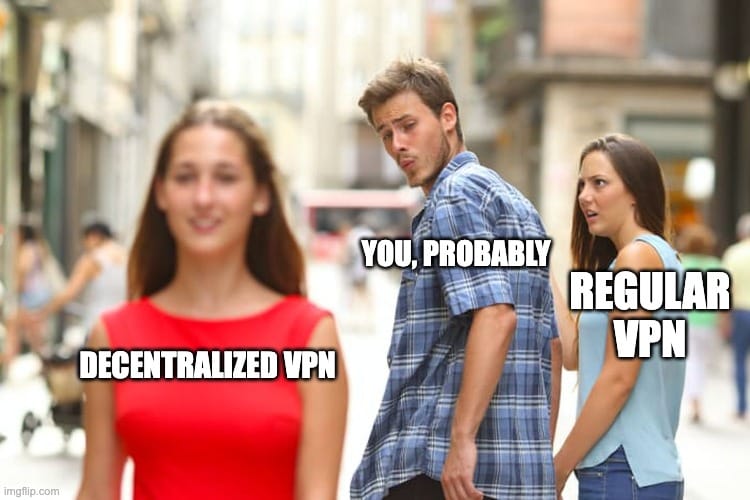
The biggest misconception here is how your traffic is handled. Most dVPN marketplaces are strictly single-hop: no traffic-splitting, no multi-node chaining, and no mixing your data with anyone else's. VPN blogs love throwing around buzzwords like "multi-hop" or "packet-split", sometimes using both terms in the same breath before quietly admitting that compromising the connection takes a single node. The reality for most of these networks is much simpler and less high-tech, which is probably why marketing copy tends to dance around it.
It gets weirder, because "decentralized" means completely different things depending on which app you download:
- Deeper Network hitches a ride straight through other people’s living room Wi-Fi routers.
- Mysterium lets everyday users rent out their home connections, though its consumer app uses a two-node "Double VPN" detour.
- Orchid skips regular people entirely and routes you right back through commercial VPN companies.
- Nym isn’t a bandwidth marketplace at all, but a multi-hop mixnet that hides your data inside artificial "cover traffic" like a digital flash mob.
Lump all these together, and you might end up staking your privacy on a dead project, or one that was just a regular VPN wearing a blockchain hat all along. And that brings up a glaring question: if you're trying to dodge centralized control, how do dVPNs actually stack up against traditional VPNs, or older volunteer networks like Tor?
dVPN vs VPN vs Tor vs mixnet: What Actually Differs
Most "VPN vs. dVPN" comparisons act like there are only two choices on the menu, completely ignoring veteran volunteer networks like Tor or cutting-edge architectures like mixnets (routing protocols that mix and delay encrypted traffic).
Tor has spent over two decades using a three-hop volunteer relay network to provide free, high-friction anonymity, while mixnets add artificial delays and dummy traffic to throw off state-level surveillance. Line all four options up under a harsh light, and three core dynamics pull back the curtain on how these networks actually operate.
| Dimension | Commercial VPN | Typical dVPN | Tor | Mixnet (Nym) |
|---|---|---|---|---|
| Who runs the exit | The provider (owned or leased hardware) | An independent operator, often on a home connection | A volunteer relay operator | Operator-run mixnodes and gateways |
| Hops | 1 | 1 in many marketplaces; some consumer apps add a hop | Typically 3 | 2 (Fast Mode) or 5 (Anonymous Mode) |
| Who may see destination metadata | The provider | The node operator | The exit relay operator | In Anonymous Mode, no single hop sees both your identity and destination; Fast Mode offers less protection |
| Traffic mixing / cover traffic | No | No | No | Yes |
| Exit IP type | Data center (some residential options) | Often residential | Data center, publicly listed | Operator infrastructure |
| Payment | Card, PayPal, crypto, cash | Crypto, usually per session | Free | Card, crypto, or cash |
| Speed | Fast and consistent | Variable by node | Slow | Slower in Anonymous Mode, faster in Fast Mode |
| Who's the likely first point of contact | The provider | The node operator | The relay operator | The operator |
| Published third-party audit | Varies by provider | Rare, see the next section | N/A (open source, widely studied) | Yes |
Who sees your destination domains
This is where dVPNs deviate sharply from Tor and mixnets. While Tor multi-hops your data so no single relay knows both who you are and where you're going, a standard dVPN hands your unencrypted DNS queries and destination traffic directly to a single stranger running a node off their home connection.
Who is legally on the hook
Tor relies on non-profit volunteer relays, and standard VPNs rely on corporate legal shields. Swapping a standard VPN for a dVPN quietly shifts the crosshairs of internet accountability.
When someone uses the network to do something sketchy, copyright notices, abuse complaints, and local authorities don't knock on a corporate legal department's door. They land directly on the doorstep of the person hosting that node.
Rolling the dice on speed
Tor is notoriously slow because it bounces your traffic across three international volunteer nodes for free. Commercial VPNs are fast and consistent.
Single-hop dVPNs fall right in the middle: they aren't inherently slow, but they are a total roll of the dice. You're trading a consistent data-center firehose for whatever garden hose your randomly assigned node host happens to have lying around, kinks and all.
The Exit Node Problem
Here's a fair question: if nearly every website already uses HTTPS encryption, why does it matter that a stranger's computer sits between you and the internet?
Because HTTPS hides less than people think. Picture your traffic as a letter in a sealed envelope. The letter inside is locked away. Nobody along the route can read your messages, your passwords, or the pages you're looking at. But the address on the outside is written in plain ink, because the internet needs it to deliver anything. Every time you visit a site, your device announces where it's going twice: once when it asks "what's the address for this website?" (the DNS lookup), and again when it names the site while setting up the encrypted connection. On most devices, neither announcement is encrypted.
Both pass straight through the exit node. So the stranger running it can't read your private messages, but they can keep a timestamped list of every single website you visit. That's not a small consolation prize.
We know this works in practice, because researchers from Northwestern University and Nokia Bell Labs did it. In 2022, they ran their own exit nodes on Mysterium, Sentinel, and Tachyon and simply watched what came through. Their data is a snapshot from early 2021, and Mysterium's app has since added a second node in front of its exit, but the numbers speak for themselves: 27% of the traffic leaving Mysterium's nodes was porn (12% on Sentinel, 2% on Tachyon), while less than 2% of all traffic was anything malicious.
In other words, what flows through these networks is mostly ordinary people's ordinary browsing.
The usual defense is that node operators filter out problem traffic with blocklists. But the researchers couldn't find a published blocklist for any of the networks (you can't audit a filter you aren't allowed to see) and none of them force the encryption that would close the leak.
None of this means every node operator is spying on you. The real problem is simpler: they easily can, and nothing in the design of a single-hop dVPN stops them.
Which brings us to the other side of the coin. If you aren't the user on a dVPN, but the person hosting the node, that structural design flips from a privacy risk into a direct liability.
If You Run a Node, You Become the Provider
If you aren't using a dVPN, but hosting a node instead, that structural design flips from a privacy risk into a personal liability.
The pitch for becoming an operator is passive crypto income, and yes, that's very tempting, but in return, you're agreeing to become the visible origin point for a total stranger's online activity. When something malicious leaves your IP address, law enforcement officers or abuse complaints will land on your front door.
dVPN platforms admit this in their own terms. Mysterium’s legal terms state they cannot guarantee operators will avoid legal exposure. There's a real case, too. When a German node runner received a formal copyright claim, clearing his name required Mysterium support staff to pull timestamped connection records. Proving innocence depended on keeping connection logs, the exact paper trail a privacy network is supposed to eliminate.
This risk isn't new, but the honesty surrounding it is. The Tor Project has operated volunteer relays for over two decades and gives a blunt warning for free: never run an exit relay from home because you will eventually hear from police or ISPs.
dVPN platforms pay people in crypto to do the identical task, but rarely lead with the warning. High-profile raids, including the 2017 arrest of a Russian mathematician for illegal posts sent through his home node, show that hosting an exit guarantees your IP is the first name on a police report.
What Happens When the VPN Company Gets Seized
The dVPN world holds up one central nightmare scenario to prove its worth: what happens when a traditional VPN company gets raided, subpoenaed, or forced off the air?
It’s a fair point. A centralized VPN is still just one company, and one company can be targeted by courts or law enforcement. But taking an honest look at what actually happens when authorities knock on our door reveals a trade-off dVPN marketing rarely mentions.
We don't have to talk in hypotheticals here. We have our own real-world record:
- Ukraine (June 2021): Authorities seized two of our unencrypted legacy servers during an investigation, exposing a server certificate and private key sitting on disk. We published the disclosure ourselves, admitted the failure, revoked the keys, eliminated on-disk key storage entirely, and rebuilt our stack.
- Greece (April 2025): Investigators targeted a server IP address used in an alleged breach, subpoenaed the hosting provider, and charged our co-founder personally. Two years later, the charges were thrown out for lack of evidence, with our founder summarizing the defense in seven words: you cannot hand over what you do not have.
- The Netherlands (February 2026): Police pulled a server straight out of a data center rack without a warrant to "fully analyze" it. Because we run RAM-only infrastructure, powering the hardware down instantly wiped the volatile memory, leaving behind nothing but a blank Ubuntu install and zero logs.
Every single one of these moments is the exact scenario dVPNs are sold to fix. But decentralization doesn’t eliminate this legal pressure; it simply relocates it.
A commercial VPN provider operates as a single, accountable legal shield. Our legal team handles the subpoenas, our engineers maintain RAM-only servers, and our founders go to court in Athens so users don’t have to.
On a single-hop dVPN bandwidth marketplace, that corporate shield is gone. When investigators track suspicious traffic back to an exit IP address, the subpoena or police search warrant doesn't land on a privacy company's legal department. It lands at the front door of the independent node operator who hosted the connection.
On a centralized VPN, the provider takes the heat. On a dVPN, the everyday person running the node becomes the provider.
Where Decentralized VPNs Genuinely Win
After looking at the privacy and legal trade-offs, it's easy to write off dVPNs entirely. But dismissing the technology ignores the real-world scenarios where decentralized networks actually outperform traditional commercial VPNs.
First, residential IP addresses bypass VPN blocks. Commercial VPN providers rely on massive data centers whose IP address ranges are well-known and easy for streaming services or firewalls to block en masse. A dVPN exit node usually runs on an ordinary household connection, making your connection look like a regular family checking their email rather than someone using a privacy tool.
Second, dynamic node lists are much harder to censor. If a government wants to block a commercial VPN, it can simply mandate ISPs to blacklist the provider’s published server list. Blocking a decentralized network requires tracking down thousands of individual, constantly shifting residential IP addresses, making dVPNs far more resilient against strict state-level firewalls.
Finally, you remove the single corporate target. While a single company can be coerced, raided, or forced to hand over logs, no single entity has the technical or physical control to pull down an entire peer-to-peer network.
Which One Should You Actually Use?
The right choice comes down to your actual threat model rather than the marketing pitch:
- For everyday privacy, streaming, and torrenting: Use a reputable commercial VPN. You get reliable speeds, professional support, audited no-logs claims, and a corporate entity taking the legal liability off your shoulders.
- If you are fighting heavy censorship or VPN blocks: A dVPN makes sense here. Residential exit nodes are far harder for strict state firewalls to detect and block en masse, though you trade away guaranteed performance and trust an unknown stranger with your unencrypted DNS requests.
- If your threat model involves state-level traffic analysis: Use a multi-hop mixnet or Tor. Bandwidth marketplaces aren't built to defend against targeted surveillance, whereas mixnets route your traffic across multiple encrypted hops with timing delays specifically designed to throw off adversary tracking.
- If you are thinking about running a node for passive crypto: Reread the operator disclaimers, check local laws, and decide if you are genuinely comfortable letting a total stranger’s unvetted internet traffic flow directly out of your home Wi-Fi.
dVPN vs. VPN: Who's the Winner?
Decentralized VPNs sound like the ultimate anti-establishment privacy tool, but they don't erase trust. They just redistribute it.
Instead of trusting a registered VPN company with audited infrastructure and a legal team to take the heat, you trust an unvetted stranger running a node from their living room, hoping they aren't logging your unencrypted destination metadata while you take on the risks of single-hop routing.
If your goal is daily privacy, streaming, and having an accountable shield when things go wrong, stick with a commercial VPN. If you're bypassing aggressive state censorship, dVPN residential IPs can be a useful tool. But if you're looking for true anonymity, look at a mixnet or Tor.
And if you're thinking of hosting a node for passive crypto, make sure you're comfortable having a stranger's unvetted traffic leave the internet under your name.

Frequently Asked Questions
What is a decentralized VPN?
A dVPN routes your traffic through independent, user-run nodes instead of a single company's servers, usually powered by cryptocurrency payments. While this removes a central provider, many of these networks operate on a single-hop setup. This means the stranger hosting your exit node can often still see your destination domains or unencrypted DNS queries.
Are decentralized VPNs legal?
Using a dVPN is completely legal in most places, just like using a standard VPN. Running a node is generally legal too, but it makes you the visible origin point for a stranger's internet traffic. If someone uses your connection for something illegal, you become the first name on the law enforcement or abuse report.
Do decentralized VPNs work?
The ones actively maintained by developers certainly do, but performance depends on what you need. They excel at dodging regional censorship because residential node IPs rarely look like VPN traffic. However, speeds are notoriously hit-or-miss since you rely on a stranger's home connection, and several featured dVPN projects have quietly abandoned development over time.
Are dVPNs cheaper than regular VPNs?
It depends entirely on how much data you consume. Standard VPNs charge a flat monthly or annual subscription, whereas dVPNs usually run on a crypto-based, pay-as-you-go model per megabyte or session. Light users might save money with a dVPN, but heavy streamers and torrent-lovers will likely spend far more than a fixed monthly bill.
Is Tor a decentralized VPN?
No, Tor is a free, non-profit anonymity network that bounces your traffic through three volunteer relays without crypto payments or bandwidth marketplaces. It prioritizes heavy multi-hop anonymity over speed, whereas dVPNs are commercial bandwidth marketplaces focused on incentivizing independent operators.
Can I use a dVPN for torrenting?
Technically yes, but it is rarely a good idea. Torrenting routes heavy peer-to-peer traffic right through an ordinary person's residential Wi-Fi, consuming their personal bandwidth. More importantly, it dumps all the legal notices and copyright complaints straight onto the node host's front door.


