




Tor and a VPN are different tools built for different problems. In short, Tor is an anonymity network designed to hide who you are, while a VPN is a privacy and encryption tool designed to hide what you’re doing.
The decision comes down to your specific threat model. If you’re a journalist, a whistleblower, or an activist whose safety depends on staying hidden from a well-resourced adversary, you need the anonymity of Tor. For everyone else looking to protect their daily traffic from ISPs, advertisers, and hackers without sacrificing speed, a VPN is enough.
But what actually is Tor, beyond the Dark Web reputation most people associate it with? In this guide, we'll break down the real speed numbers, the leak risks each tool misses, and exactly how to choose the right one for your specific threat model.
What Is Tor, Really?
The first thing that pops into your mind when you think of Tor is likely the Dark Web. And yes, Tor is the default browser people use to peruse the dark, scary corners of the Deep Web. But that’s not the only thing it’s for, and it’s not the Dark Web itself. It’s a sophisticated network run by The Tor Project, a non-profit dedicated to online anonymity.

There are really two parts to understand: the Tor Browser, which is the app you download, and the Tor Network, which is the global network of volunteer-run servers moving your traffic around. Tor stands for The Onion Router, and the onion isn’t just a funny name. It works exactly as it sounds: your data gets wrapped in layers of encryption, and each server removes one layer at a time to figure out where to send it next.
When you use Tor, your traffic usually passes through three nodes. The entry node sees your real IP but not your destination. The middle relay just passes traffic along and sees neither end clearly. The exit node sends your request to the website, so it sees the destination, but not who you are.
That’s the whole point of Tor’s design. No single server knows both who you are and where you are going. That gives Tor a real anonymity advantage, but it also means you are relying on a decentralized network of volunteers, which is part of why it can feel slow compared to a VPN.
Tor Project also launched a VPN-style mobile product in late 2025, but the core Tor network still works on this same three-hop model. And that is what makes it so different from a VPN, which uses a much more direct and centralized setup.
What Is a VPN, Really?
A VPN, short for Virtual Private Network, creates a secure, encrypted tunnel between your device and a VPN server. Instead of your internet traffic going straight out through your regular connection, it gets sent through that server first. That server then masks your real IP address with its own before your traffic reaches the wider internet.
That setup is a big reason VPNs are usually much faster than Tor. Tor sends your traffic through multiple volunteer-run hops, while a VPN sends it straight to one server. Fewer stops, less overhead. Modern VPN protocols like WireGuard, OpenVPN, and IKEv2 are built to keep that process fast enough for things like 4K streaming, gaming, and regular everyday use.
A VPN also protects your whole device, not just one browser. That means your apps, background connections, and system traffic all go through the VPN tunnel.
The tradeoff is trust. With Tor, trust is spread across a decentralized network. With a VPN, you’re trusting one provider instead of your ISP. That’s the biggest philosophical difference between the two, and it shapes how each tool handles privacy and anonymity.
Privacy vs Anonymity: The Main Difference
If you take only one thing away from this guide, let it be this: privacy and anonymity are not synonyms. Most tech blogs use them interchangeably, but in the world of security, mixing them up is a fundamental error.
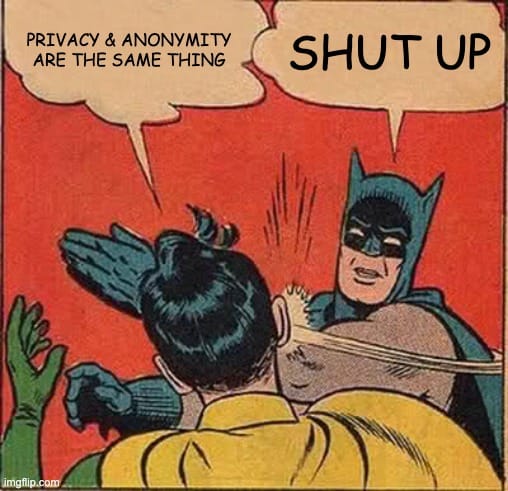
A VPN gives you privacy. Tor gives you anonymity.
Privacy is about hiding what you’re doing. When you use a VPN, your ISP, the government, and the guy sniffing packets on the coffee shop Wi-Fi can see you’re there, but they have no idea which websites you’re visiting or what files you’re downloading. Your VPN provider still knows who you are because you have a relationship (and likely a payment history) with them.
Anonymity, on the other hand, is about hiding who you are. When you use Tor correctly, your identity isn’t linked to your activity. Not even the network itself knows both your origin and your destination.
That difference matters most when you look at threat models. Your threat model is just a fancy way of asking: who are you trying to hide from, and what can they actually see? Your adversary’s capability matters too. An advertiser, your ISP, or the random person on coffee shop Wi-Fi has a very different level of visibility than a state-level actor or a serious investigator.
But unless you’re a Russian spy, wanted by the state, hiding from some powerful hackers, or just snooping around the Dark Web, you don’t need Tor. For normal people dealing with normal online threats, a VPN is usually enough.
Is a VPN Faster Than Tor? Let’s Run the Numbers
Yup! A VPN is always faster than Tor, pretty much due to the fact that with a VPN your data doesn't go through multiple layers of encryption and three different global hops.
Using Tor can feel like going back to the internet from 2005. It typically sits somewhere at 500 KB/sec, which is about 4 Mbps, on most circuits, and while you might hit more on a lucky path, it’s unpredictable by design. A VPN using WireGuard can comfortably hit 300 to 750+ Mbps on a decent home line with a tiny 5% to 10% overhead compared to your native speed.
The reason for this gap is… physics. Tor’s speed is capped by the slowest volunteer relay in your three-node circuit. If your middleman is a laptop in a basement with bad Wi-Fi across the ocean, your whole connection crawls. A VPN hits one high-performance server, often geographically close to you. Even the older OpenVPN protocol only adds about a 20% to 30% speed penalty compared to WireGuard, which still leaves Tor in the dust.
This creates very different practical realities for how you actually use the internet. 4K streaming works perfectly on a VPN, but is a buffering nightmare on Tor, and video calls are fine on a VPN, while Tor’s high latency makes them unusable. Torrenting is technically possible on Tor, but it’s considered socially hostile because it clogs a narrow pipe built for people who need anonymity to stay alive.
Speed is the most obvious trade-off, but the next one is just as important: how much of your actual device is being protected?
What Does Each One Actually Protect?
It’s a common myth that Tor protects you online in the same way a VPN does, but the reality is that they cover very different parts of your digital life.
The easiest way to think about it is by looking at the scope of the protection. Tor is almost entirely focused on what you do inside a specific window, while a VPN is focused on the data leaving your entire device.

What Does Tor Protect (and What It Doesn’t)
Tor is primarily built into the Tor Browser, which means its protection is browser-only. Everything you do inside that browser is wrapped in onion routing and is incredibly well-shielded against browser fingerprinting, which is when sites identify you by your screen size, fonts, and unique settings.
However, any other app on your device, like your email client, Spotify, or Steam, is completely ignored by Tor. Their traffic goes straight to the internet over your normal connection, revealing your real identity. This is the single most common misunderstanding about Tor: it’s a secure room you walk into, not a suit of armor you wear everywhere.
What Does a VPN Protect (and What It Doesn’t)
A VPN offers device-wide coverage by sitting at the network layer. This means every app on your device, even the ones running in the background, has its traffic encrypted and sent through the tunnel. While a VPN is great for masking your IP globally, it doesn't stop browser fingerprinting. A website can still see your unique browser settings and identify you that way, even if your IP address is different.
A VPN is also only as good as the app itself. If the software is sloppy, you can suffer from DNS or IPv6 leaks that reveal your activity to your ISP anyway.
One of the most persistent threats is the WebRTC leak, which uses your browser’s own real-time communication features to snitch on your real IP address. We actually built WebRTC Slayer specifically to kill this problem, as it’s a leak class that most standard VPN tunnels can’t catch on their own.
Side-by-Side Comparison
While Tor and a VPN share some common ground, they’re architecturally different tools.
| Dimension | Tor | VPN |
|---|---|---|
| Primary Purpose | Anonymity (hiding identity) | Privacy (hiding activity) |
| Architecture | 3-hop routing via volunteer nodes | 1-hop to a provider-run server |
| Encryption | Layered per hop, stripped at exit | End-to-end (WireGuard/OpenVPN) |
| Post-Quantum Ready | Not currently production-ready | Rolling out; Windscribe supports PQ key exchange |
| Speed | 1 to 5 Mbps (Typical) | 300 to 750+ Mbps (Typical) |
| Device Coverage | Tor Browser only (mostly) | Entire device |
| IP Masking | Automatic circuit rotation | User-selected server locations |
| .onion Access | Yes | No |
| Cost | Free | Paid (Windscribe offers a free plan) |
| Trust Model | Decentralized (no single party) | Centralized (trust the provider) |
| Ideal User | Whistleblowers, journalists | Everyday users, streamers, gamers |
Three differences matter most: who you’re trusting, how ready the tool is for the future, and how much of your device it actually covers.
First, there’s trust. Tor spreads trust across a bunch of volunteer-run nodes, so no single party should know both who you are and where you’re going. A VPN is more centralized, which means you’re trusting one provider instead of your ISP. That is why a no-BS, no-identifying-logs policy like ours matters.
Second, there’s post-quantum readiness. Most people don’t really need to stress about this yet, but it does show where each tool is headed. Tor is built for anonymity. VPNs are moving faster on newer encryption upgrades, and Windscribe already supports post-quantum key exchange.
And lastly, there’s coverage. Tor mostly protects what you do inside Tor Browser. A VPN protects your whole device, including apps and background traffic. That makes it a lot more practical for everyday use.
When Tor Is Actually the Right Tool
There are absolutely situations where a VPN is the wrong tool, and Tor is the right one. If your safety depends on staying invisible to a powerful adversary, a VPN, no matter how good, introduces a single point of failure that Tor does not.
For the vast majority of people reading this, though, who don’t operate in high-stakes scenarios, a VPN is perfectly fine. You likely just want to watch Netflix without being tracked or stop your ISP from selling your data. But if you’re in a situation where your physical safety depends on anonymity, a VPN is a less private choice than Tor.
Scenario 1: You’re a whistleblower
If you’re a whistleblower leaking documents or sending tips to an organization through SecureDrop, you should be using Tor.
When you use a VPN, you’re placing a company in the chain of custody for your identity. Even with a strict no-logs policy, that’s a link in the chain that a high-stakes source shouldn't risk. Tor removes the middleman entirely, ensuring that the organization receiving your documents has zero way to trace them back to your physical location.
Scenario 2: You live under active surveillance
For dissidents and activists in countries where VPN traffic is actively flagged, blocked, or even criminalized, a standard VPN handshake is a red flag to the authorities.
Tor offers pluggable transports like Snowflake or obfs4 that disguise your traffic to look like a normal video call or harmless web browsing. A VPN makes your traffic unreadable, but Tor can make it invisible.
Scenario 3: You need to access .onion services
There’s a legitimate side to the Dark Web that has nothing to do with scary stories. Many privacy-focused email providers, news outlets, and human rights organizations maintain .onion mirrors of their sites.
These versions are hosted within the Tor network itself, making them more resistant to censorship and easier to access for people in restricted regions. A VPN can’t reach these addresses. Only the Tor Browser can.
Using Tor and a VPN Together
You can absolutely stack these two tools, but just because you can doesn't always mean you should. Combining them is like wearing two pairs of sunglasses: you might get extra shade, but you’re also going to have a much harder time seeing where you’re going. In the privacy world, we call these setups "Tor over VPN" and "VPN over Tor."

Tor over VPN
This is the most common stacking setup: you connect to your VPN first, then fire up the Tor Browser. From your ISP’s perspective, you aren't using Tor; you're just using a VPN. On the other end, the Tor entry node doesn't see your real home IP address; it only sees the VPN server’s IP.
The trade-off is that you have to trust your VPN provider. While your ISP is in the dark, the VPN company can see that you’re connecting to the Tor network.
VPN over Tor
This setup is much more complex. You connect to Tor first, then tunnel a VPN connection through it. It’s rare because it’s painfully slow and difficult to configure. The only real reason to do this is if you want to access a website that normally blocks Tor users, but you still want to hide your Tor usage from the VPN provider itself.
Unless you have a very specific technical reason and an anonymous way to pay for your VPN, this usually isn't worth the headache.
But… Should You Actually Do It?
The Tor Project itself officially recommends against combining a VPN with Tor for most users. Their guidance is clear: misconfiguring these stacks can actually reduce your anonymity instead of adding to it.
The Tor network is designed to work best when you blend in with everyone else. By adding a VPN to the mix, you create a unique traffic signature that can actually make it easier for a sophisticated observer to pick your connection out of the crowd.
Verdict: Which Should You Use?
Choosing between Tor and a VPN isn't a matter of better or worse. It’s a matter of choosing the right tool for the job you’re doing right now. It comes down to this:
- Use a VPN if you want daily privacy, fast speeds for streaming and gaming, and encryption that covers every app on your device.
- Use Tor if your threat model involves a serious adversary, you need absolute anonymity, or you need to access .onion services.
- Use both only if you are an advanced user with a specific technical reason to stack them.
For the majority of people, a VPN provides the best balance of security and usability. Windscribe's free plan offers 10 GB of data every month with the same encryption standards and no-logs policy as our paid tiers. This gives you plenty of room to see if a VPN fits into your daily routine without any upfront commitment.

Frequently Asked Questions
Is Tor safer than a VPN?
It depends on what you mean by safe. For total anonymity and hiding your identity from a powerful adversary, yes, Tor is safer because it distributes trust across three random nodes. However, for protecting your entire device's data and preventing hacking on public Wi-Fi without a massive speed penalty, a VPN is the stronger, more practical tool.
Can Tor replace a VPN?
No. Tor is primarily designed to protect the traffic inside the Tor Browser. While it’s great for that specific window, your other apps, like your email client, music apps, or system updates, still leak your data over your normal connection. A VPN provides a blanket of encryption that covers every single byte of data leaving your device.
Is it illegal to use Tor?
In most countries, including the U.S., UK, Canada, and the EU, using Tor is legal. It is a tool for privacy used by millions of people every day. However, it is restricted or blocked in a short list of countries like China and Russia. Just remember: while the tool itself is legal, what you do while using it is still subject to your local laws.
Do I need a VPN if I only use a Tor Browser?
Not necessarily. If your only goal is anonymous browsing and you don't care if your other apps (like Spotify or your email) go over your regular connection, Tor Browser is enough. But if you want device-wide privacy and browser anonymity, you can use both. Just keep in mind the Tor Project’s caution about misconfiguring stacked connections.
Why is Tor so slow?
Tor is slow by design. Your data has to travel through three different volunteer-operated nodes, often located on different continents, before it reaches its destination. Each hop adds latency, and your total speed is limited by the slowest relay in that chain. It is optimized for anonymity, not for streaming or high-speed downloads.
Is the Tor VPN app the same as a regular VPN?
No. The Tor Project’s VPN app (which hit beta in September 2025) is a specialized tool for mobile privacy. Unlike a traditional VPN that routes everything through a single provider's servers, this app uses per-app routing to send traffic through the Tor network. It’s designed for bypassing censorship on your phone, not as a high-speed replacement for a standard VPN or the full Tor Browser.


