



Finding L2TP in a protocol dropdown in 2026 is the digital equivalent of digging through a junk drawer, pulling out a dusty VGA cable, and briefly wondering if you still need it. Technically, it might serve a purpose in one hyperspecific edge case. Practically, it's a warning sign that you're about to have a very frustrating afternoon.
If you're staring at an old router settings page or another VPN's menu, you've probably seen IKEv2 and L2TP sitting side-by-side like two identical options. They aren't. One is a modern mobile powerhouse, and the other is a bloated relic that belongs in a museum next to dial-up tone modems.
Let's settle the showdown and explain why we flat-out refuse to put L2TP in our app.
What IKEv2 and L2TP Actually Are
Neither IKEv2 nor L2TP actually encrypts your VPN traffic by themselves. They're tunnel builders, not security guards. To actually protect your data, both lean heavily on IPsec, the underlying cryptographic engine doing the heavy lifting.
Think of it like moving apartments. L2TP is a standard moving truck: it hauls your stuff from point A to point B without caring who peeks inside. IKEv2 is the negotiator who sets up the security detail beforehand, agreeing on keys and check-ins.
Neither one is the actual padlock on the door. That's IPsec's job in both cases. Because they share the same security foundation, the real differences come down to how they handle the plumbing.
IKEv2
IKEv2 (Internet Key Exchange version 2) acts as the brain of the operation. It negotiates authentication, establishes encryption keys, and handles connection recovery. When you select IKEv2 in a VPN app, you're actually running IKEv2/IPsec. It handles the handshake, while IPsec encrypts the data path. It’s lean, ultra-fast on mobile, and smart enough to keep your connection alive when your phone hops from Wi-Fi to cellular.
L2TP
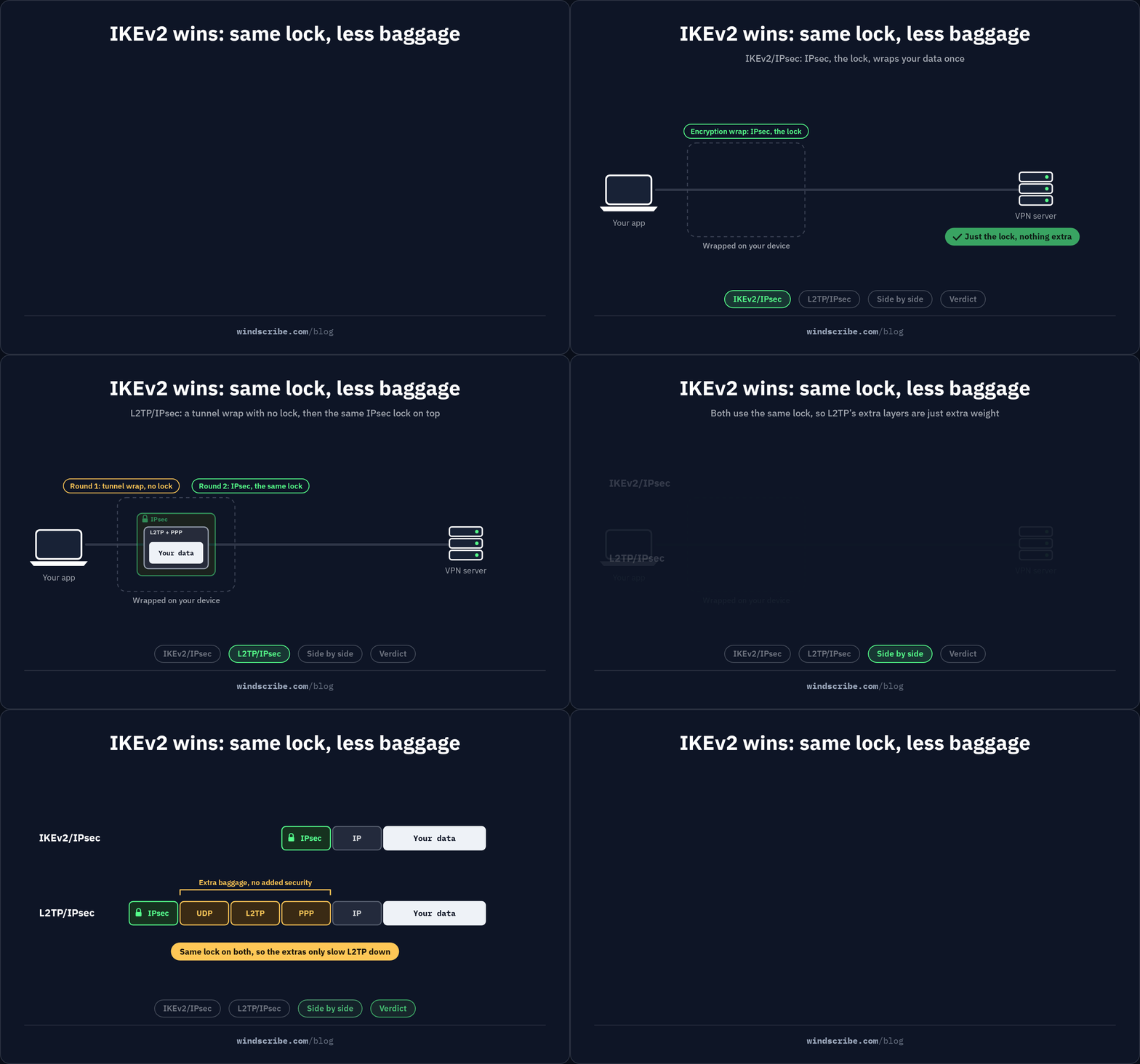
L2TP (Layer 2 Tunneling Protocol) is a whole different beast. It only builds the tunnel to route your packets, providing zero encryption on its own. To make it safe, it gets paired with IPsec (L2TP/IPsec), but it drags along legacy PPP (Point-to-Point Protocol) plumbing and extra encapsulation. This creates unnecessary overhead, essentially wrapping a box inside another box, without offering a single modern security advantage in return.
IKEv2 vs L2TP, Head to Head
If this were a fair fight, we'd tell you to grab popcorn. Instead, it's more like watching a modern athlete race someone wearing lead shoes. While both protocols rely on IPsec for encryption, their architecture makes them behave like night and day in the real world.
Here's how they stack up when you put them through their paces.
| Dimension | IKEv2/IPsec | L2TP/IPsec |
|---|---|---|
| Speed | Faster, lower overhead | Slower, double encapsulation |
| Network switching | Survives via MOBIKE | Drops, forces reconnect |
| Mobile suitability | Strong | Weak |
| Encryption | Modern IPsec configs; Windscribe uses AES-256-GCM | IPsec encryption, often older configs |
| Firewall / ports | UDP 500 + 4500, blockable | Fixed well-known IPsec/L2TP ports, easy to block |
| Compatibility | Native iOS, macOS, Windows | Broad legacy support |
| Current status | Current, widely deployed | Legacy fallback, increasingly de-emphasized |
*These are typical outcomes for a properly configured connection on each side. Your actual experience depends on your device, your network, and how carefully your provider implemented each protocol. Treat this as the general shape of things, not a guarantee.
Speed (Not Close)
IKEv2 travels light. L2TP doesn't. The reason is structural: L2TP double-encapsulates every packet, wrapping it once for tunneling and then again with IPsec. Two rounds of processing, every single packet.
On a modern device with a fast connection, the gap is real but tolerable. On an older device, a weaker cellular signal, or during a sustained large file transfer, that overhead compounds: lower throughput, higher latency, consistently.
The popular idea that “modern hardware makes this negligible” only holds under ideal conditions. In practice, double-encapsulation costs you something every time, usually right when you'd most like it not to.
Stability & Mobility (Also Not Close)
This is the biggest practical gap for anyone using a VPN on a phone. IKEv2 supports MOBIKE (Mobility and Multihoming Protocol), which lets an active tunnel survive an IP address change. Walk out of the house and your phone switches from Wi-Fi to cellular: IKEv2 is much better at surviving that change or reconnecting cleanly. L2TP has no equivalent mechanism.
When the network changes, the tunnel drops and you're reconnecting from scratch. For desktop users parked on one connection all day, this is academic. For phone users, it happens every time you leave the house, and nobody enjoys a VPN that flinches every time they walk past their own driveway.
Compatibility: L2TP's One Actual Win
To be fair: L2TP is baked into nearly every legacy OS and a long list of older routers. No third-party app to install. On hardware that predates modern VPN clients, that can genuinely matter. It's the honest reason L2TP still exists. It doesn't make L2TP a good protocol. It makes it available. (These are very different things.)
The Security Question: Is L2TP Still Safe?
People love to claim L2TP is fundamentally compromised, but the real issue is simpler: it’s just hopelessly out-of-date. L2TP isn't necessarily broken, it's just stuck wearing clothes from a decade ago that no longer fit modern security needs.
Because L2TP usually lives on ancient routers and legacy hardware, it often relies on dated default settings and weak pre-shared keys. Worse, it broadcasts its presence over fixed, well-known ports (UDP 500, 4500, and 1701), painting a massive target on its back for anyone looking to block it.
Compare that to modern IKEv2, which runs top-tier cipher suites like AES-256-GCM out of the box. L2TP can still technically encrypt your data, but choosing it today is like opting for a flip phone when you have a smartphone in your pocket.
The Firewall Myth: Why Neither Beats Censorship
Many tech blogs call IKEv2 "firewall-friendly" because of its NAT traversal (NAT-T) support. Don't be fooled. NAT-T simply helps your traffic pass through your home router, but it does absolutely nothing to hide you from a censor.
Both IKEv2 and L2TP use rigid, predictable ports that make them ridiculously easy for strict Wi-Fi networks or hostile firewalls to spot and slam shut. In protocol terms, they both walk into the room wearing name tags that say "I am VPN traffic." If you're on a heavily restricted network, skip both and use obfuscated protocols (like our Stealth or WStunnel). They disguise your connection as normal web browsing so you can slip right past blockades.
Why Windscribe Doesn’t Offer L2TP
We don't offer L2TP for the same reason we don't offer a “make your connection worse” button. It solves almost nothing that IKEv2, WireGuard, OpenVPN, Stealth, or WStunnel don't already solve better.
Remember that L2TP provides no encryption by itself. It runs on fixed, well-known ports that make it easy to identify and block, and its real-world deployments tend to trail behind current IPsec practice. All of the downsides, none of the perks.
The protocol lineup already covers everything a user needs, faster and more reliably. Adding L2TP would mean offering a weaker option with no upside over what's already there, plus the real risk that someone picks it by default because it's in the list.
So Which Should You Use? Probably WireGuard, But Definitely Not L2TP
For most users, WireGuard is the right protocol. It's faster, lighter, and simpler than both IKEv2 and L2TP. The IKEv2 vs L2TP matchup is worth understanding, but if WireGuard is available, that's usually the answer before this question even comes up.
Between IKEv2 and L2TP specifically: choose IKEv2 in almost every case where those are the only two options, with one narrow carve-out. On genuinely old hardware where L2TP is the only native option and OpenVPN also won't load, L2TP is what you have. Otherwise, it's IKEv2.
Here's how that shakes out by scenario:
- Mobile user switching between Wi-Fi and cellular: IKEv2 (for MOBIKE) or WireGuard.
- Maximum speed: WireGuard.
- Restrictive or censored network: Not IKEv2, not L2TP. Use Stealth or WStunnel.
- Old router with no modern client: L2TP only if nothing else is supported. Prefer OpenVPN if the router supports it.
In Windscribe's app, Automatic mode selects a protocol and port for you based on the connection environment. Manual mode lets you choose supported protocols directly, including IKEv2 and WireGuard. L2TP isn't in the list, and now you know why.

Frequently Asked Questions
Is IKEv2 the same as IPsec?
No. They work together but do different jobs. IKEv2 negotiates and manages the keys and the secure tunnel. IPsec handles the actual encryption. In consumer VPNs, you usually see them paired as IKEv2/IPsec.
Is L2TP still safe to use in 2026?
L2TP/IPsec can still encrypt traffic, but it runs on fixed, well-known ports that make it easy to block, and on older hardware it may rely on dated defaults or limited configuration options. There's no advantage over a current protocol. Avoid it unless old hardware genuinely leaves no other option.
Is IKEv2 faster than L2TP?
Yes, consistently. L2TP wraps every packet twice: once for tunneling, once for encryption. IKEv2 doesn't carry that overhead. The gap is most visible on slower connections, older hardware, and during sustained high-throughput transfers.
Does L2TP work on routers when IKEv2 doesn’t?
Sometimes. On older routers, L2TP is natively available, whereas modern VPN clients can't be installed. That's its main remaining use case. If the router supports OpenVPN or WireGuard configs, prefer those.
Why do some VPNs not offer L2TP anymore?
Because it adds a slower, easily blocked option with no benefit over IKEv2, WireGuard, or OpenVPN, and with real-world implementations that tend to lag behind current practice. The decision to drop it is intentional, not a gap in the lineup.
IKEv2 vs WireGuard: which should I choose?
WireGuard for raw speed and a smaller, auditable codebase. IKEv2 for deep native-OS integration on mobile and MOBIKE's network-switching stability. Both are strong. See the dedicated IKEv2 vs WireGuard comparison for the full breakdown.


