



One hill I’d die on is that pineapple absolutely belongs on pizza. Another hill, though much nerdier and far less likely to ruin a dinner party, is that your VPN protocol choice actually matters.
Why? Because it affects how fast you connect, how your VPN behaves when your network changes, how well it survives restrictive Wi-Fi, and how much battery it chews through on your phone. But names like WireGuard, IKEv2, and the like sound like something out of a movie about hackers in hoodies. Not helpful, unless you know exactly what they are, what they do, and when to use each.
The short version is this: WireGuard is the default pick for most people because it’s fast, lean, and efficient. IKEv2 still earns its keep on mobile, where its ability to handle network switching is genuinely useful.
Now let’s get into why.
What WireGuard and IKEv2 Actually Are
Both WireGuard and IKEv2 are VPN protocols, which means they do the same basic job: they secure your connection and send your traffic through an encrypted tunnel. The difference is in how they do that and what they were built for.
WireGuard is the newer one. It launched in 2016 and was designed around a simple idea: keep it fast, modern, and lightweight. Its codebase is famously tiny, around 4,000 lines, which matters because less code usually means fewer places for bugs and security issues to hide.
It also sticks to one fixed set of modern cryptographic tools, including ChaCha20-Poly1305, Curve25519, and BLAKE2s, instead of giving developers a giant menu of options. It was originally built as a Linux kernel module, with user-space versions for other platforms, and it uses the Noise IK handshake to establish a secure connection very quickly.
IKEv2 is the older, more established option. It has been around since 2005, and when you see it in a VPN app, it usually means IKEv2/IPsec. In other words, IKEv2 helps set up the connection, and IPsec handles the actual protection of your data. It typically uses AES-GCM and SHA-2, runs on UDP ports 500 and 4500, and is best known for MOBIKE, a feature that helps keep the VPN alive when your phone switches from Wi-Fi to mobile data.
At a high level, WireGuard was built to be lean, fast, and hard to misconfigure. IKEv2 was built to be flexible and stable in more traditional network environments. That split explains pretty much every difference that comes next.
Speed: What You'll Actually Feel
Since nobody enjoys watching a webpage load like it is buffering in 2009, speed is one of the first things people care about when picking a VPN protocol.
The short answer is this: on most modern hardware and stable networks, WireGuard is faster than IKEv2. Not in a life-changing, angels-singing kind of way, but by a measurable margin you can actually feel.
Why? Mostly because of plumbing. WireGuard was built to be lean, with less per-packet overhead and a simpler handshake. On Linux, it lives in the kernel, which lets it move traffic with less fuss. IKEv2 has more setup steps and more IPsec machinery humming in the background, which adds a bit more weight. It’s not slow. It’s just carrying more luggage. That’s also why WireGuard tends to be easier on your phone’s battery during long sessions.
There’s one caveat, though. On older hardware, especially older iPhones and legacy Windows machines, that gap can shrink a lot. IKEv2’s deep OS integration on those platforms can help it punch above its weight.
Here’s what the speed picture usually looks like on modern hardware and stable networks:
| Metric | WireGuard | IKEv2 |
|---|---|---|
| Handshake time | Under 100ms | 200 to 500ms |
| Gigabit throughput | 800 to 950 Mbps | 700 to 850 Mbps |
| CPU at gigabit | ~5% | ~10 to 15% |
| Battery impact | Usually lower | Usually higher |
Security: Which Is Actually More Trustworthy
Security obviously matters. But unless you’re Ethan Hunt sprinting across a rooftop with three governments after you, you don’t need to treat this like a cryptographic cage match. If you’re a normal person looking for normal security against current everyday threats, both WireGuard and IKEv2 do the job.
WireGuard uses a fixed modern cryptographic stack built around ChaCha20-Poly1305, Curve25519, and Perfect Forward Secrecy (PFS) through its Noise IK handshake. IKEv2, usually paired with IPsec, commonly uses AES-GCM, SHA-2, and Diffie-Hellman-based key exchange, and it also supports PFS.
Where they differ is in how they get to “secure.” WireGuard is strict. It gives you one modern set of tools and skips the giant menu of options. That’s good for security because fewer options mean less room for downgrade attacks and fewer chances for someone to accidentally mess things up. IKEv2 is more flexible, which is useful, but that flexibility also creates more room for bad configuration.
WireGuard also gets a lot of love for being small enough to audit like a real piece of software instead of a cursed cathedral of legacy code. Its core protocol has been formally verified, so yes, it’s safe. No, that doesn’t mean it has the same multi-decade public track record as IPsec. IKEv2 has a much longer history, deeper enterprise scrutiny, and more implementation baggage.
And let’s not forget about the awkward IPsec footnote. Snowden-era reporting showed that the NSA was actively trying to weaken or bypass parts of internet encryption, including major standards. It’s not proof that modern IKEv2 is broken, but it’s something to keep in mind.
Mobile Reality: Wi-Fi to 5G Without Dropping
As you leave the coffee shop, your phone realizes the cafe Wi-Fi is gone and frantically jumps onto 5G. In that split second, your IP address changes. On a bad day, this is where your VPN connection goes to die, leaving your data exposed while your phone tries to reconnect for ten agonizing seconds.
That’s exactly what IKEv2 was built to prevent. It uses an extension called MOBIKE (Mobile IKE), which was built specifically for this scenario. When your IP changes, MOBIKE tells the VPN server, "Hey, it’s still me, just a different house," and preserves the existing security association. The transition happens in under a second. It handles aggressive NAT rebinding and simultaneous IP changes with the grace of a professional gymnast, while other protocols usually trip over the floor mats.
WireGuard doesn’t have a specific mobility extension because it relies on a stateless design. It doesn't handshake in the traditional, clingy way older protocols do. If a packet arrives from a new IP but has the correct cryptographic tag, the server just accepts it and moves on.
This works great about 95% of the time, though you might notice a 2 to 3-second pause while the tunnel re-establishes itself. It’s effective, but it’s more brute force than the elegant handoff of IKEv2.
iOS vs. Android Reality
If you’re an iPhone user, the choice gets even more granular. IKEv2 is a first-class citizen in Apple’s ecosystem. It’s the only protocol you can configure as a native iOS VPN profile with On Demand rules directly in the Settings app.
This means you can tell your iPhone to automatically fire up the VPN the second you join an untrusted network without even opening an app. WireGuard, while excellent, still requires a third-party app (like Windscribe) to manage the connection.
On Android, the gap is smaller as both protocols are well-supported, but WireGuard typically wins on battery drain. Because it’s so lean, it doesn't wake your processor up as often, meaning your phone might actually survive until you find a charger.
Essentially, if your daily life involves walking through three different dead zones and four different Wi-Fi networks, IKEv2’s MOBIKE is a genuine lifesaver.
Firewalls, Ports, and Restrictive Networks
If you’re trying to use a VPN at a high-security office, an airport with a restrictive captive portal, or while traveling through countries like China, Iran, or the UAE, speed becomes a secondary concern. The only question that matters is: will it even connect?
This is where IKEv2’s enterprise maturity actually becomes a target on its back. Because it’s a standardized industry veteran, everyone knows exactly how to spot it. IKEv2 strictly uses UDP ports 500 and 4500. For a firewall admin or a government ISP, blocking IKEv2 is as simple as closing two digital doors. Plus, the protocol has a very distinctive handshake (the initial connection greeting), making it stupidly easy for Deep Packet Inspection (DPI) to identify and throttle it in seconds.
WireGuard has a slight advantage here because it’s port-agnostic. It can be configured to run on any UDP port you want, allowing you to hide your traffic on a port usually reserved for something else. However, WireGuard lacks a native TCP fallback. Since it only speaks UDP, a firewall that blocks all UDP traffic, which is a common tactic in hostile networks, will kill a WireGuard connection instantly. Like IKEv2, WireGuard’s handshake is also recognizable to sophisticated DPI filters.
In genuinely hostile environments, neither WireGuard nor IKEv2 is the right tool for the job. They weren't built to be invisible. They were built to be secure and fast. When these protocols get blocked, you need obfuscation, which is the technology that disguises VPN traffic as standard HTTPS web browsing.
Setup Complexity and Platform Support
There are two ways to look at setup: clicking a button in an app or hand-rolling a configuration from scratch. If you're using the Windscribe app, the difference is exactly one click. But for the DIY crowd and the self-hosters, the reality is a bit more nuanced.
WireGuard is famously simple to set up manually. The process usually involves a sub-100-line config file containing your key pair and a few endpoint details. However, let's be real: the five-minute setup everyone talks about is true for the client, but it’s rarely true for a hardened server. Getting a WireGuard server running with proper firewall rules and DNS routing still requires a baseline level of Linux comfort.
IKEv2 is a different beast. Setting it up manually on a server using strongSwan or a similar IPsec daemon is often a weekend project. You have to manage certificates, RSA keys, or Pre-Shared Keys (PSK), along with complex routing table logic. It isn't necessarily worse, it just does more, providing the kind of granular control that enterprise networks crave.
Native Support and Routers
One of IKEv2’s biggest advantages is that it’s natively supported by Windows, macOS, iOS, and Android. You can set it up in your iOS Settings or Windows VPN menu without downloading a single piece of software. This allows for Always On and On Demand rules that third-party apps sometimes struggle to replicate.
WireGuard has been part of the Linux kernel (5.6+) for years, ensuring top-tier performance on Linux machines and most modern routers like OpenWrt or pfSense. While IKEv2 is more common on off-the-shelf consumer router firmware, WireGuard is rapidly becoming the standard for anyone who cares about throughput.
Split Tunneling, Kill Switches, and Other Features
Let’s play MythBusters, shall we? Some top-ranked articles claim that WireGuard doesn’t support split tunneling or kill switches, making it less feature-rich than IKEv2. That’s not true.
The thing is that protocols like WireGuard and IKEv2 don’t implement split tunneling or kill switches. VPN apps do.
Split tunneling is a routing decision made by your client software. It decides which traffic goes through the encrypted tunnel and which goes out through your regular ISP. Whether the underlying tunnel is WireGuard or IKEv2 is irrelevant. Any serious VPN app, Windscribe included, offers Split Tunneling regardless of which protocol you toggle.
The same rule applies to the kill switch. A kill switch (or what we call our Firewall) is a set of OS-level rules that prevent data leaks if the connection drops. It isn't a feature of the protocol itself but a safeguard built into the VPN. At Windscribe, our Firewall works exactly the same whether you’re using WireGuard or IKEv2.
There is, however, one legitimate protocol-level difference: Dead Peer Detection (DPD). IKEv2 has DPD built directly into its DNA to check if the connection is still alive. While this sounds good, it can sometimes be a bit over-sensitive, causing false-positive disconnects if your network gets congested. WireGuard has no native equivalent, making it slightly more forgiving on unstable connections, though it requires the VPN app to handle its own liveness checks.
If a comparison guide tells you WireGuard can’t handle split tunneling, they are confusing the plumbing with the faucet.
Post-Quantum and What's Coming Next
Large-scale quantum computers capable of snapping current elliptic curve cryptography like a dry twig don’t exist yet. However, "Harvest Now, Decrypt Later" is a very real threat. This is where state actors capture your encrypted data today and sit on it like a digital time capsule, waiting for the day a quantum computer can pop the hood.
In their default states, both WireGuard and IKEv2 are vulnerable to this future threat. The difference lies in how we fix them. WireGuard’s fixed cipher suite means a post-quantum retrofit is a "measure once, cut once" job. Because there is less to coordinate, we can swap in quantum-resistant algorithms for everyone at once.
IKEv2 is more flexible but more bureaucratic. While RFC 8784 allows for post-quantum pre-shared keys, implementing it requires a complex negotiation between the client and the server that feels a bit like trying to get two different government agencies to agree on a lunch spot.
The good news? We aren't waiting around for the Quantum Apocalypse. As of late 2025, Windscribe has already upgraded our WireGuard implementation to be quantum-resistant across all devices using a hybrid X25519 + ML-KEM key exchange. That sounds like something a robot would yell before opening a portal, but it really just means your connection uses both today’s trusted encryption and a newer quantum-resistant method, so your data is better protected now and later.
In reality, nobody is quantum-safe in 2026… We’re all just quantum-resistant. It’s an arms race, and we’re currently in the lead.
WireGuard vs IKEv2: The Side-by-Side Matrix
If you’ve been skimming until now, this is the part you’ll want to screenshot. The table below condenses the technical trade-offs we have discussed into a single view.
| Dimension | WireGuard | IKEv2 | Windscribe Take |
|---|---|---|---|
| Speed & Latency | Ultra-fast (Sub-100ms handshake) | Fast (200-500ms handshake) | WireGuard is the undisputed throughput king. |
| Security Auditability | High (~4,000 lines of code) | Low (Complexity is an audit hurdle) | WireGuard is easier to trust because there’s less to hide. |
| Mobile Roaming | Stateless (2-3 second delay) | MOBIKE (Sub-1 second resume) | IKEv2 is still the commuter’s choice for stability. |
| Censorship | Port-agnostic but UDP only | Fixed ports (500/4500) | Both fail against serious DPI; use Stealth instead. |
| Setup (Manual) | Simple (Short config file) | High (Requires certificates/RSA) | WireGuard is the only sane choice for DIY setups. |
| Native Support | Requires an app on most platforms | Built into iOS, Windows, and macOS | IKEv2 wins if you hate installing extra apps. |
| Battery Impact | Very Low (CPU efficient) | Moderate (Higher CPU overhead) | Use WireGuard if your phone is always at 10%. |
| Liveness (DPD) | Client-side detection | Native Dead Peer Detection | IKEv2 is more proactive, WireGuard is more chill. |
| Post-Quantum | PQ-Ready (Windscribe hybrid) | Roadmap (RFC 8784) | WireGuard is currently more future-proof. |
Which One Should You Use: A Decision Tree
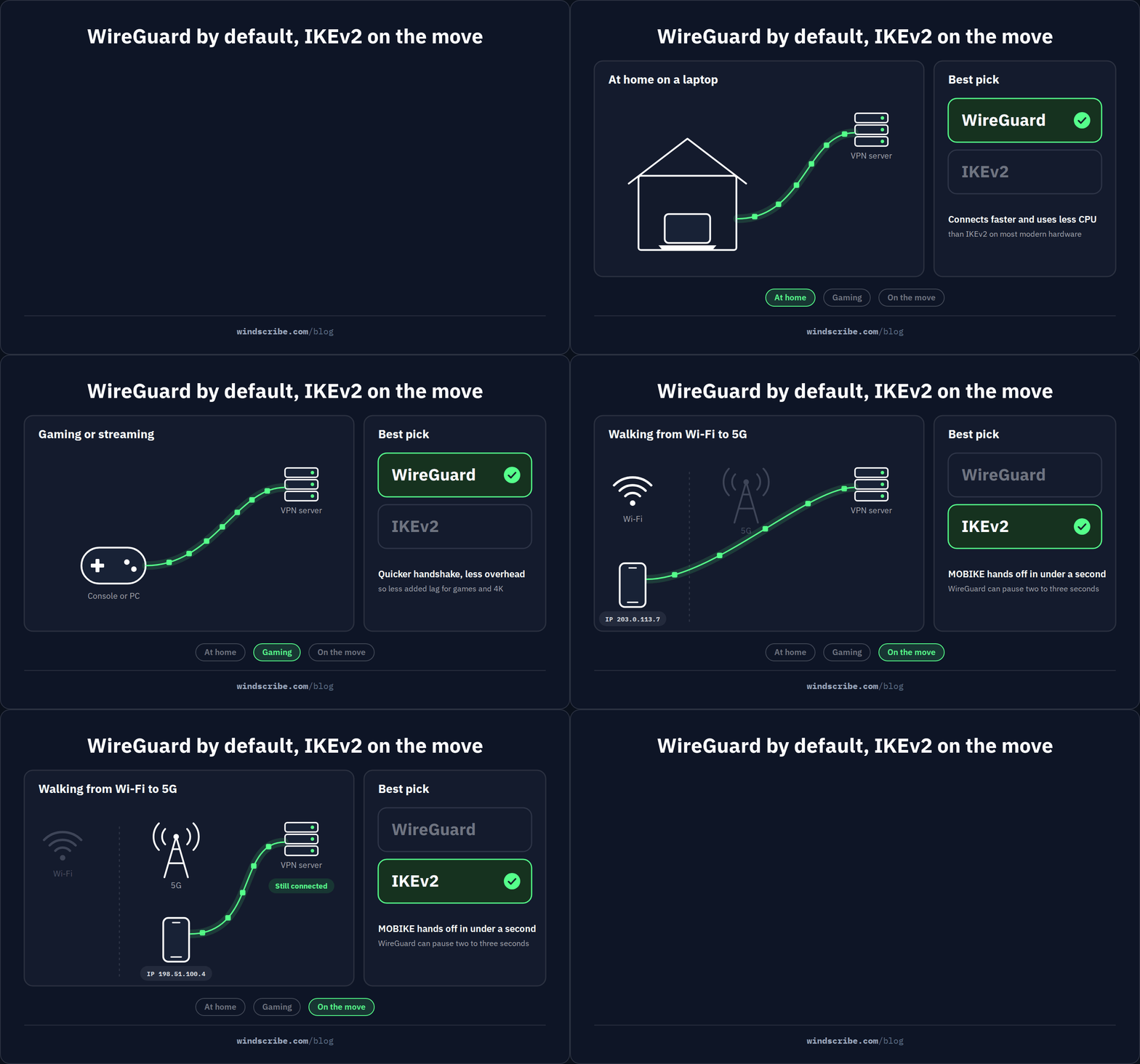
While both protocols are technically impressive, they aren't interchangeable. Depending on what you’re doing right now, one of these is objectively better than the other.
Scenario 1: The Day-to-Day
If you’re sitting on your couch with a laptop or tablet just trying to keep your ISP out of your business, use WireGuard. It’s the modern default for a reason. It connects faster, uses less of your computer's brainpower, and will max out your internet speeds more consistently than IKEv2.
Scenario 2: The Commuter (Mobile & Wi-Fi)
If you’re on a phone and your life involves walking out of the house, onto a train, and into an office, you have two choices. Use IKEv2 if you want the absolute gold standard of stability. Its On Demand profiles and MOBIKE support mean your VPN won't even blink when you switch to 5G. However, if you find that WireGuard’s 2-second reconnect doesn't bother you, stick with WireGuard to save your battery.
Scenario 3: The Competitor (Gaming & Streaming)
When every millisecond of ping matters or you’re trying to stream 4K video on a VPN without the spinning circle of death, use WireGuard. Its lower handshake latency and reduced per-packet overhead make it the better choice for high-bandwidth, low-latency tasks, which is a large part of why a VPN sometimes increases ping on older protocols.
Scenario 4: The Hostile Network (Censorship & Firewalls)
If you’re at a restrictive office or traveling in a country that actively hunts VPN traffic, the answer is actually neither. WireGuard and IKEv2 are too easy to spot. Switch to Stealth or WStunnel to disguise your traffic as normal web browsing and slip past the firewall.
Scenario 5: The DIYer (Self-Hosted VPS)
If you’re setting up your own VPN server on a VPS, use WireGuard. It’s significantly easier to configure and maintain. Only suffer through a strongSwan/IKEv2 setup if you have a specific requirement for native IPsec clients that cannot install third-party apps. If you want Windscribe's speed without our app, just use our Config Generator (you need to be either on Pro or Build-A-Plan).
WireGuard vs IKEv2 Frequently Asked Questions
Is WireGuard more secure than IKEv2?
Both protocols are extremely secure, but they take different paths to get there. WireGuard uses a less-is-more approach with a tiny codebase that is much easier for security experts to audit for bugs. It uses modern, fixed cryptography like ChaCha20. IKEv2 is more complex and flexible, which means there is more room for configuration errors, but it has a twenty-year track record of battle-tested security in enterprise environments.
Is IKEv2 still worth using in 2026?
Absolutely. While WireGuard is the shiny new standard, IKEv2 is still the best protocol for mobile users. Because it supports MOBIKE, it handles the jump from Wi-Fi to 5G better than almost anything else. If you live in an area with spotty cell service or you are constantly switching networks, IKEv2 is often more stable than WireGuard.
Which VPN protocol is the fastest?
WireGuard generally wins the speed race. Because it lives inside the Linux kernel and has very low overhead, it can hit higher top speeds and connect much faster (usually in under 100ms). IKEv2 is no slouch and can still handle gigabit speeds, but the handshake process, where the app connects to the server, takes a bit longer.
Does WireGuard work on iPhone and iPad?
Yes, it works great. You can use WireGuard on iOS through the official Windscribe app or the standalone WireGuard app. While IKEv2 used to have a slight edge on Apple devices because it’s built directly into the iOS Settings menu, WireGuard’s modern app implementations are now just as easy to use and often lighter on your battery.
What is the difference between WireGuard and IPsec?
WireGuard is a single, streamlined protocol that handles everything from encryption to the connection itself. IPsec is a larger suite of different protocols that work together. Think of WireGuard as a modern electric car built from the ground up, while IPsec is a high-end internal combustion engine with a lot of moving parts that require more tuning.
Is IKEv2 the same as IPsec?
Not exactly, but they’re almost always paired together. IKEv2 (Internet Key Exchange version 2) is the part of the conversation that handles the handshake and sets up the secure tunnel, while IPsec is the framework that actually encrypts and moves the data. When you see IKEv2 in your VPN settings, it’s shorthand for IKEv2/IPsec.
Which protocol uses less battery on mobile?
WireGuard is typically the winner here. Because it’s so lean and efficient, it puts less strain on your phone's processor. IKEv2 is also efficient, but its more complex encryption process can lead to slightly higher battery drain during long sessions. If you care about battery optimization, WireGuard is the better choice.
Does Windscribe support both protocols?
Yup, we do! We even support six: WireGuard, IKEv2, OpenVPN on UDP and TCP, and our specialized Stealth and WStunnel protocols. We believe in giving you the right tool for the job. You can switch between them instantly in our app settings to see which one works best for your specific network.


