




If VPN protocols were like high school archetypes, OpenVPN would be the theater kid who can convincingly play any role but takes twenty minutes to put on their makeup. IPsec, specifically IKEv2/IPsec, would be the varsity athlete: incredibly fast and reliable on the field, but they get confused if you ask them to use a different entrance to the gym.
Most people staring at the protocol menu in their VPN app are looking for a simple "best one here" button. The reality is that we have mostly moved past the era where this was a two-horse race.
While we spend most of our time in 2026 recommending WireGuard, the specific differences between OpenVPN and IPsec still matter the moment you try to connect to a hotel Wi-Fi that was last updated in 2012, where you may also run into IPsec passthrough settings, or find yourself crossing a national border with a very strict firewall.
So, neither one is objectively better, but each one has a lane. OpenVPN is better at surviving restrictive networks. IKEv2/IPsec is better at staying fast and stable on mobile.
Now, let’s break down what each one actually is, why they feel so different, and when you would still use either in 2026.
OpenVPN vs IPsec at a Glance
OpenVPN is the Swiss Army knife in your digital glove box: it might be a little slower to pull out and use, but it has a tool for almost every weird situation, especially when a restrictive firewall is trying to shut you down.
IKEv2/IPsec is more like a high-performance motorcycle: it’s built for speed and seamless movement, making it the ideal companion for a smartphone that’s constantly jumping between 5G towers and the Wi-Fi at your local Starbucks.
Here’s a quick comparison between the two:
| Feature | OpenVPN | IPsec (IKEv2/IPsec in VPN apps) |
|---|---|---|
| Full name | OpenVPN | Internet Protocol Security |
| Year introduced | 2001 | 1995 (IKEv2 in 2005) |
| Layer | Transport Layer | Network Layer |
| Default ports | UDP 1194, TCP 443 | UDP 500, UDP 4500 |
| Encryption | AES-256, ChaCha20, PFS | AES-256, ChaCha20, PFS |
| Speed | Fast (High overhead) | Very Fast (Low overhead) |
| Firewall tolerance | High (via TCP 443) | Low (Easily blocked) |
| Best for | Bypassing restrictions | Mobile devices and speed |
While both protocols use top-tier encryption like AES-256 and support Perfect Forward Secrecy to keep your past sessions private, they go about their business in fundamentally different ways.

What Is OpenVPN?
OpenVPN is the grizzled veteran of the privacy world. Released in 2001 by James Yonan, it’s an open-source protocol built on the OpenSSL library. It uses SSL/TLS for key exchange, which is the same fundamental security logic that puts the padlock icon in your browser bar when you’re buying overpriced vintage sneakers on eBay.
It usually runs on UDP (port 1194) for better speed, but its real superpower is the ability to switch to TCP (port 443). Because port 443 is what normal web traffic uses, OpenVPN can effectively camouflage your VPN connection as standard internet browsing to slip past nosy firewalls.
If you go searching for documentation, you might get a bit confused because OpenVPN is currently used to describe three different things. There’s the actual open-source protocol (the set of rules for the connection), the open-source software (the code that implements those rules), and OpenVPN Inc. (the commercial company that sells a product called Access Server).
When you see OpenVPN in a consumer VPN app, you’re using the open-source protocol, not buying into a corporate ecosystem or using a commercial business product.
What Is IPsec (and What Your VPN App Actually Means by It)?
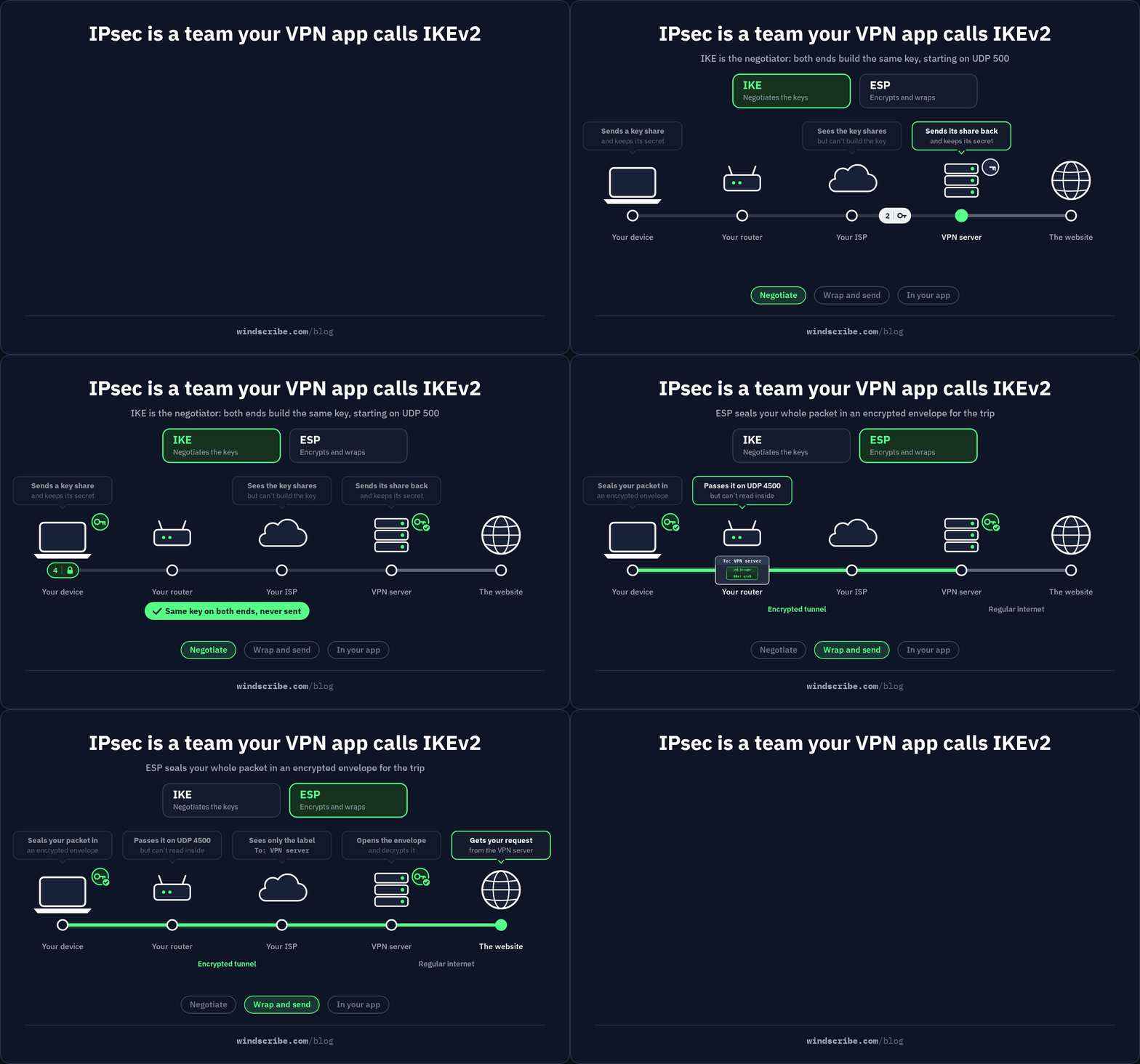
If OpenVPN is a standalone novel, IPsec is more like a massive library of technical manuals. Developed by the IETF, IPsec isn’t a single protocol but a suite of them working together at the network layer.
Think of it as a security team: you have ESP (Encapsulating Security Payload), which handles the heavy lifting of encrypting your data; AH (Authentication Header), which is a bit of a relic that verifies where data came from but is rarely used in modern VPNs; and ISAKMP or IKE (Internet Key Exchange), which is the negotiator that decides how your device and the server will talk to each other.
To actually work as a VPN, IPsec has to run in tunnel mode, which wraps your entire data packet in a new, secure envelope. It generally relies on UDP 500 to negotiate the initial handshake and UDP 4500 for NAT traversal, which is just the technical way of saying it helps your VPN traffic find its way through your home router’s firewall without getting lost.
Now, in corporate IT, IPsec usually refers to a permanent tunnel connecting two massive office buildings. However, in a consumer VPN app, the label IPsec almost always refers specifically to IKEv2/IPsec. This is a modern pairing that fixed the clunky connectivity issues of the past, making the connection much more resilient when you’re doing something like walking out of your house and switching from your home Wi-Fi to a 5G signal. In the Windscribe app, the protocol labeled IKEv2 is IKEv2/IPsec.
You might occasionally see someone on a forum claiming that IPsec is weak or compromised. Usually, they’re yelling about IKEv1 or ancient L2TP/IPsec setups that use weak pre-shared keys (basically a shared password that everyone knows, which is as secure as leaving your house key under a very obvious welcome mat). Modern IKEv2/IPsec is a completely different beast and remains a top-tier choice for security.
Security: How Do They Really Compare?
Both protocols are incredibly secure when implemented correctly.
Both support the heavy hitters of modern encryption, including AES-256, ChaCha20-Poly1305, and the SHA-2 family. They also both use Perfect Forward Secrecy, which ensures that even if a hacker somehow steals a private key today, they still can’t go back in time and decrypt your past sessions. It’s like changing the locks on your house every ten minutes: by the time a thief copies the key, it no longer fits the door.
OpenVPN is famously flexible, pulling from the massive OpenSSL library to offer authenticated encryption that verifies your data while it secures it. IKEv2/IPsec is slightly more opinionated but no less strong, typically sticking to a more rigid set of high-performance ciphers. The real difference lies in public proof. Because OpenVPN is a unified open-source project, it’s easier to audit.
As for the persistent rumors that the NSA broke IPsec, which you may have heard somewhere, these almost always stem from Snowden-era leaks regarding IKEv1. That version had genuine weaknesses in how it handled key exchanges, but those holes were plugged with the arrival of IKEv2/IPsec. If you’re using a modern VPN app in 2026, you aren't using the legacy version.
Performance: Speed, Mobility, and Battery
If VPN protocols were cars, OpenVPN would be a sturdy, reliable overlanding rig. It can go anywhere, but it’s heavy, and it takes a minute to get up to highway speeds. IKEv2/IPsec is more like a sleek electric sedan. It’s built for efficiency, handles corners effortlessly, and accelerates the moment you touch the pedal.
The technical reason for this gap comes down to where the protocol lives inside your device. IKEv2/IPsec runs in the kernel space, which is the inner sanctum of your operating system where the high-priority tasks happen. OpenVPN, however, runs in the userspace, meaning it has to constantly ask the operating system for permission to process data. This back-and-forth creates a tax on your CPU and slows things down.
Because of that, IKEv2/IPsec is the winner in all three categories: speed, mobility, and battery drain. But let’s look at the why.
Speed and Throughput
In our internal testing across our global server network, we see IKEv2/IPsec consistently edge out OpenVPN on raw throughput. On a standard 500 Mbps home fiber connection, the difference is usually around 10 to 20 percent. While OpenVPN can close this gap on short network hops using UDP, IKEv2 stays more consistent over long distances.
Handshakes and Mobility
Ever walked through a crowded airport, switching frantically between your cellular data and the spotty terminal Wi-Fi while trying to load your boarding pass? Yeah, that’s where IKEv2/IPsec can save your VPN connection from dropping and your IP address from leaking every time you switch between networks.
That’s because IKEv2/IPsec uses a feature called MOBIKE (Mobility and Multihoming Protocol). This allows the VPN to keep your session alive even when your IP address changes. OpenVPN, by contrast, often has to re-negotiate the entire connection when you switch networks, which can lead to a 5 to 10-second blackout where your internet just... stops.
MOBIKE is also the main reason IKEv2 still holds its own against newer protocols, which is the comparison most people are really making: WireGuard or IKEv2, not OpenVPN or IPsec.
Battery Drain
Because IKEv2/IPsec is more efficient at the CPU level, it’s significantly lighter on your battery. This is especially true on iOS devices, where Apple has baked IKEv2 directly into the system's plumbing.
OpenVPN is a bit more of a power-hungry guest. Because it has to work harder in the userspace to keep your data moving, you might notice your phone getting a little warmer and your battery percentage dropping faster during a long Netflix binge.
Compatibility and Ease of Use
Aaaaand the winner is… IKEv2/IPsec. Once again. It wins the compatibility and ease of use category because it’s native on almost every modern operating system (meaning that you get to use the built-in settings panels that came with your device).
The cost of this convenience, though, is a lack of knobs. You get fewer configuration options, and you’re at the mercy of OS vendor bugs. If Apple breaks a specific part of the macOS network settings, you have to wait for a system update to fix your VPN.
OpenVPN, on the other hand, requires a third-party client. That’s the core difference. If you want to use OpenVPN, you usually have to download an app like OpenVPN Connect or a provider's client. If you want to use IKEv2/IPsec, your device likely already knows how to speak the language without you having to install a single byte of new software.
This makes OpenVPN the king of the DIY crowd because there’s a ton of documentation out there. If you are trying to set up a tunnel on a pfSense box or a Raspberry Pi, there are roughly a billion tutorials online to help you. Setting up an IKEv2/IPsec server from scratch is notoriously finicky.
| Operating System | IKEv2/IPSec Native Support | OpenVPN Native Support |
|---|---|---|
| Windows 10/11 | Yes (via VPN Settings) | No (Requires app) |
| macOS 12+ | Yes (via Network Settings) | No (Requires app) |
| iOS 15+ | Yes (via VPN Configuration) | No (Requires app) |
| Android 10+ | Yes (via Settings) | No (Requires app) |
| Linux | Yes (via strongSwan) | Yes (via Package Manager) |
| Routers (OpenWrt/pfSense) | Yes (Native integration) | Yes (Native integration) |
Firewall Traversal and Censorship Resistance
And the Oscar goes to… OpenVPN. In this category, OpenVPN is the undisputed heavyweight champion because it knows how to play dress-up. Most protocols are stuck wearing their own clothes, but OpenVPN can put on an HTTPS costume and walk right through the front door of most restricted networks.
The technical reason for this comes down to an unfair asymmetry in how these protocols handle ports. IKEv2/IPsec is pinned to UDP 500 and UDP 4500. These are the equivalent of wearing a giant neon sign that says "I AM A VPN." If a network admin wants to block VPNs, they just close those two little digital doors, and your connection is dead.
OpenVPN, however, can run on TCP 443. Because TCP 443 is the same port used by almost every website on earth (including the one you’re reading right now), a network usually can't block it without breaking the internet entirely.
This plays out in three very real scenarios:
The Aggressive Airport Scenario
You’re at a terminal waiting for your flight, and the free Wi-Fi only lets you browse the web. Because they have blocked everything except web ports, IKEv2/IPsec will fail to connect. OpenVPN on TCP 443 will likely slide right through because the router can’t tell that you’re using a VPN.
The Corporate Overlord Scenario
You’re on an office network that uses Deep Packet Inspection (DPI). This is a more sophisticated security guard that doesn't just look at the port costume, but also at the data inside. Even with HTTPS mimicry, a good DPI system can often spot the fingerprint of an OpenVPN handshake and shut it down. You’d need something even more inconspicuous.
The Great Firewall Scenario
In regions with heavy national censorship, like China, Iran, Russia, or the UAE, neither raw OpenVPN nor raw IKEv2/IPsec is enough. These firewalls are built to identify and kill standard VPN traffic within seconds.
Which One Should You Pick?
By now, you’ve seen the guts of both protocols. But you aren’t here for a computer science degree. You’re here to fix your connection. If you’re staring at your settings menu trying to decide which toggle to flip, here’s when to choose each.
Pick OpenVPN If...
OpenVPN is your best bet if you’re currently stuck on a restrictive network, such as a hotel Wi-Fi or a school campus where the administrators act like digital prison guards. In these cases, switching OpenVPN to TCP 443 is your ultimate survival mode.
It’s also the correct choice if you’re a DIY enthusiast running a home VPN server on a pfSense box or a Raspberry Pi, as it’s the most documented and least surprising protocol to set up.
Also, it’s the necessary fallback for legacy routers or older devices that lack support for more modern standards, or for anyone traveling in a high-censorship region who needs an obfuscation layer like Stealth or WStunnel to stay under the radar.
Pick IKEv2/IPsec If...
Choose IKEv2/IPsec if you’re primarily a mobile user who moves a lot between the 5G tower and your local coffee shop Wi-Fi. Because IKEv2/IPsec reconnects smoothly between networks, you don’t need to worry about your VPN connection dropping and manually reconnecting it every time you walk in and out of a Wi-Fi network’s range.
Plus, it’s built directly into the brain of your phone or laptop, so you can set it up in your device settings without downloading a single app. If you’re an iPhone or Mac user, this is the protocol Apple likes best, meaning it plays very nicely with your phone’s battery life.
Skip Both and Use WireGuard If...
Tbh, in 2026, the best advice for almost everyone is to just ignore the OpenVPN vs. IPsec debate entirely and go for WireGuard instead. If your VPN provider offers it, use it. It’s faster, it’s leaner, and it reconnects almost instantly.
To put it in perspective, OpenVPN is like a massive, 100,000-line legal contract that takes a team of lawyers to verify. WireGuard is about 4,000 lines of code. This makes it much easier for security experts to check for holes and much faster for your processor to handle. Unless you’re trying to punch through a very specific firewall or you have a weirdly specific technical reason to stay old-school, WireGuard is the undisputed daily driver.
Our Honest Take for 2026
Use WireGuard. That’s it. That’s our take.
Why? Because it’s the most modern, secure, and lightweight protocol there is. At least, for now. WireGuard officially landed in the Linux kernel in 2020 and has effectively sucked the air out of the room ever since. It was designed by Jason Donenfeld to replace the bloat of older protocols with cutting-edge math like Curve25519, ChaCha20-Poly1305, and BLAKE2.

While OpenVPN is a sprawling 100,000-line behemoth that requires technical knowledge to fully audit, WireGuard is roughly 4,000 lines of code. It’s the difference between checking a studio apartment for dust mites and trying to deep-clean a 50-room Victorian mansion. It connects faster, runs cooler, and hits higher speeds than both OpenVPN and IPsec ever could.
But, to be fully technically honest with you, WireGuard isn't a magic wand for every single scenario. It lacks built-in obfuscation, so it’s easily spotted by censors, and its default design assigns static internal IPs, which requires VPN providers to get creative with their own privacy implementations to ensure user anonymity. It’s also the new kid on the block compared to IPsec, meaning it doesn't have thirty years of battle-tested history in every conceivable hostile network environment.
OpenVPN vs IPsec Frequently Asked Questions
Is OpenVPN more secure than IPsec?
Both are rock-solid when set up correctly. OpenVPN has a slight trust edge due to a comprehensive 2017 public audit by Quarkslab, while IKEv2/IPsec has a longer history in high-stakes enterprise environments. When people claim IPsec is weak, they’re usually talking about ancient IKEv1 or L2TP setups, not the modern IKEv2/IPsec found in your VPN app.
Which is faster, OpenVPN or IPsec?
IKEv2/IPsec generally wins on speed, typically outperforming OpenVPN by 10% to 20% on a standard home fiber connection. This is because IPsec lives in your operating system’s heart (the kernel), while OpenVPN has to constantly ask for permission to process data. However, for most casual browsing, you likely won't notice the difference.
Can I use OpenVPN and IPsec at the same time?
Not within a single connection. You have to pick one horse for your tunnel to ride. You could technically run IKEv2 on your iPhone while your desktop sits behind an OpenVPN tunnel, but trying to use both at once on the same device is a recipe for a networking headache and no internet access.
Why do VPN providers list IKEv2 instead of IPsec?
IPsec is a massive suite of different protocols, many of which are outdated. By labeling it IKEv2, providers are letting you know you’re using the modern, mobile-friendly version that actually works well. It’s like saying "iPhone 15" instead of just "Smartphone."
Is IPsec deprecated?
Not at all. While the old IKEv1 version is basically a digital fossil at this point, IKEv2/IPsec is very much alive. It remains the default VPN protocol for the entire Apple ecosystem and Windows, and it continues to receive regular security updates and support.
What about L2TP/IPsec?
L2TP is the VCR player of protocols: it was great for its time, but it’s slow and easily blocked. It relies on pre-shared keys that act like a master key hidden under a very obvious doormat. Most reputable providers, including us, have retired it. If a VPN still pushes L2TP as a main feature, consider it a red flag.
Does OpenVPN or IPsec drain more battery?
OpenVPN is a bit of a power hog on mobile. Because it runs as a third-party guest on your phone, it makes your CPU work harder to move data. IKEv2/IPsec is built into the phone's native plumbing, making it much lighter on your battery. If you're on a long flight without a charger, pick IKEv2.


