



A VPN costs anywhere from $2 to $15 a month. Why the price gap? It depends mostly on the provider and how much of your future you’re willing to trade for a discount.
If you want a month-to-month plan without a long-term commitment that feels almost like marriage, most premium providers are going to cost around $9 to $15 per month.
If you’re willing to sign away a year of your life, that drops to a more reasonable $3 to $6 a month. And if you’re ready to go steady for two years or more, you can find rates as low as $1.99 a month, though you definitely need to read the fine print before you click buy.
We’re a VPN company, and we see the industry gears turning behind the scenes every day. Most of the "best VPN" guides you find online are written by affiliate sites designed to funnel you toward whichever provider pays them the fattest commission.
They have zero interest in warning you about the aggressive renewal hikes (the intro-rate-then-jack-it-up kind of thing), the completely unnecessary add-on tiers that bloat your monthly subscription bill, or the fact that your "cheapest plan” might double in price after the first year.
At Windscribe, we’re very transparent in everything we do, which includes our pricing and guides like this one. So, we’re going to tell you the entire truth about the sneaky industry practices behind VPN pricing, what to look out for, and how to spend less on your VPN subscription.
VPN Pricing in 2026: What Every Provider Actually Charges
Unlike the shiny comparison tables you’ll find on affiliate sites, here’s an honest one that includes the one column they hate talking about: the renewal price.
The "Renewal" column shows what happens when your honeymoon period ends.
Most of those ultra-cheap 2-year plans actually renew as 1-year plans at a significantly higher rate. Only Windscribe and Mullvad keep the price the same on renewal.
Note: Prices fluctuate. The rates given in the table are verified as of March 2026, the date of writing this article, and may not remain accurate forever (and probably won’t).
| Provider | Monthly | Annual (per mo) | 2-Year (per mo) | Renewal (annual per mo) | Devices | Free Tier |
|---|---|---|---|---|---|---|
| NordVPN | $12.99 | $4.99 | $3.39 | ~$11.59 | 10 | ✗ |
| Surfshark | $15.45 | $3.19 | $1.99 | ~$15.45 | Unlimited | ✗ |
| ExpressVPN | $12.99 | $6.67 | $2.44 | ~$8.32 | 8 | ✗ |
| ProtonVPN | $9.99 | $3.99 | $2.99 | ~$6.99 | 10 | ✓ (unlimited data, 1 device) |
| Windscribe | $9.00 | $5.75 | — | $5.75 (same) | Unlimited | ✓ (10GB, unlimited devices) |
| CyberGhost | $12.99 | — | $2.19 | ~$4.75 | 7 | ✗ |
| PIA | $11.99 | — | $3.33 | ~$4.16 | Unlimited | ✗ |
| IPVanish | $12.99 | — | $3.33 | ~$7.50 | Unlimited | ✗ |
| Mullvad | $5.80 | $5.80 | $5.80 | $5.80 | 5 | ✗ |
| PrivadoVPN | $10.99 | $1.33 | $1.11 | ~$4.99 | 10 | ✓ (10GB) |
If you look at the raw industry averages, monthly plans run around $11 per month, annual plans sit between $4 and $5 per month, and 2-year deals lure you in with ridiculously low $1.11 or $2.19 per month.
But these averages are based entirely on introductory pricing. Once you factor in what you'll pay on renewal, the true average cost of owning a VPN over three or four years is considerably higher.
At Windscribe, we deliberately don’t offer a 2-year plan. We aren't interested in locking you into a multi-year contract just to spike your bill later. That’s shady, to say the least.
It’s also worth noting that a lot of the companies implementing these sneaky pricing tactics are actually connected. You know, in a “who owns who” kind of way.
The providers you see on most “best VPN” lists are often just several different brands owned by the same massive parent corporation. We mapped it all out for you on our VPN Relationship Map.
Mullvad also operates on a unique flat-rate philosophy, like us, which means that whether you stay for a month or a decade, the price stays the same.
Monthly, Annual, or Multi-Year: Which VPN Plan Is Worth It?
When you’re looking at a pricing page of a VPN provider, you’re usually staring at a psychological battlefield designed to push you toward the longest commitment possible. Here is how those tiers actually function in the real world.
Monthly plans are the ultimate try-before-you-buy option, ranging from $5 to $15. They are perfect for a two-week vacation or testing if a VPN actually unblocks that one streaming service you love.
However, they are a terrible financial move for the long haul. You’ll end up paying 3 to 5 times more per month than you would on a longer plan.
Annual plans are generally the sweet spot for most people. These usually range from $3 to $6 a month, typically billed as a $40 to $70 upfront sum.
You’re cutting your costs by about 50% compared to the monthly rate, but you aren't locked in so long that you're stuck if the service goes downhill.
Plus, most competitors lure you in with a low first-year rate and then spike the price on renewal, which is… kinda unethical, and frankly, pretty rude.
Multi-year plans (2-3 years) are where the marketing gets aggressive, with labels like "$1.99/month!" plastered everywhere. The reality is a bit of a shell game.
You’re paying a significant chunk upfront, and those 3 bonus months they claim are free are actually just baked into that total price, so you aren’t really getting anything for free.
But the real sting comes at the end. Once that initial 2-year honeymoon phase is over, these plans almost always renew as 1-year plans at a much higher standard rate. That $1.99 teaser from Surfshark? It eventually rolls over into $15.45 per month. That’s a 676.38% increase. Read that again: 676.38%!
It’s the single most important detail in VPN pricing, and it’s exactly why most affiliate sites that get paid on that first click conveniently forget to mention it.
Then, we’ve got the lifetime deals, which should be avoided at all costs. Running a VPN requires constant overhead for servers, bandwidth, and security developers, and a one-time $50 or whatever payment doesn't cover those costs for more than a year or two. Usually, “lifetime” providers either let their service quality degrade into the basement, disappear entirely, or pivot their terms of service until your "lifetime" access is effectively worthless.
In this industry, if a deal sounds like a mathematical impossibility, it probably is.
What You'll Actually Pay for a VPN (The Part Most Guides Skip)
So, with all of these multi-year plans and layers deep intro discounts, what will you actually end up paying for a VPN over time? Let’s stop looking at the shiny billboard prices and look at the math.
The Renewal Price Hike Nobody Talks About
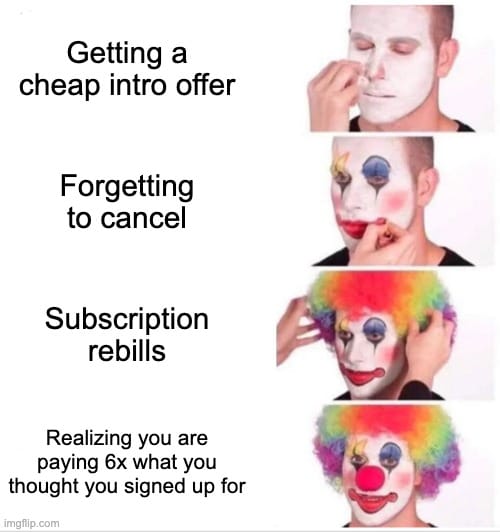
Here is how VPN pricing typically works: you sign up at a mouth-watering promotional rate, and the second that plan expires, the price jumps, sometimes dramatically.
The mechanics are simple but effective. A provider offers you a 2-year deal for a couple of bucks a month. You pay the 2-year fee and then forget about it. However, that $1.99 or $3.39 rate only applies to that first block of time. When it’s over, the plan almost always converts to a 1-year subscription at a much higher rate.
Because auto-renewal is enabled by default across the industry, you’ll be charged the new, higher price automatically unless you remember to unsubscribe on time.
At Windscribe, the price you sign up at is the price you keep. Period.

We don't do introductory rates because we don't think winning a customer involves waiting for them to forget a renewal date. We actually wrote an entire breakdown of how these pricing tactics work.
Why the Advertised Price Might Not Include What You Need
Thought you’d finally found the bottom of the rabbit hole? Not quite. There is one more pricing trick the industry has fallen in love with: tiers.
Lately, the biggest names in the business have moved away from "one price for everything" and toward a buffet-style menu where the basics are cheap but the essentials are extra.
NordVPN, for example, now funnels users into four different tiers: Basic ($3.39/mo), Plus ($3.89/mo), Complete ($5.39/mo), and Prime ($7.39/mo). That $3.39 headline price everyone quotes is for the Basic tier… which is just the VPN.
If you want what most people consider a modern security suite, like their malware blocker or a password manager, you’re looking at a bill closer to $5 or $7 a month.
ExpressVPN has followed suit with a similar ladder: Basic ($2.44/mo), Advanced ($3.14/mo), and Pro ($5.24/mo).
Whether you actually need to buy these extras from your VPN provider is highly debatable, and the answer is no.
You can get a world-class, dedicated password manager like Bitwarden for free, and your computer’s built-in antivirus (like Windows Defender) arguably does a more specialized job than the bolt-on tools VPN companies bundle to justify their higher tiers.
Windscribe takes the opposite approach: all of our major features, including our friendly R.O.B.E.R.T. ad and malware blocker, split tunneling, and firewall, are included on every single plan. There’s only one tier.
Can You Get a VPN for Free?
You can… but whether you should is an entirely different thing. Free VPNs exist. Free tiers exist. But are they actually worth it?
Yes, Free VPNs Exist, But There Are Tradeoffs
In the current market, free VPNs generally fall into two categories. First, you have freemium tiers from established, paid providers. These are legitimate services that use a free version to show you how the product works.
For example, Windscribe offers a free plan with 10GB of data per month and access to 10 countries without requiring a credit card. Proton VPN, on the other hand, offers unlimited data but limits you to a single device and a handful of randomly assigned server locations.

Then there are standalone free VPN apps. You know, the ones with generic names like "Free VPN Super" that clutter the app stores.
This is where you become the product. Recent studies have found that roughly 38% of free Android VPNs contain malware or invasive trackers.
Even more alarming, over 21 million user records have been leaked from free VPN databases in the last few years alone.
If a VPN is completely free and isn't a limited version of a paid service, you should be extremely skeptical about how they’re keeping the lights on. Usually, it's by selling your browsing habits to the highest bidder.
Money-Back Guarantees as Risk-Free Trials
Most paid providers like NordVPN, Surfshark, and ExpressVPN don't have a permanent free tier. Instead, they offer a 30-day money-back guarantee.
This is effectively a free trial with extra steps: you pay the full price upfront, test the service for a month, and then have to remember to request a refund before the 30 days are up, which most people simply don’t do.
We think it’s a bit backward to ask for your money just so you can try to get it back later.
Instead, we provide a genuinely functional free plan out of the box, without the "cancel before you get charged" traps. Simply upgrade if and when you're ready.
Pay Only for What You Use
Most VPN pricing assumes you want a global pass to every single server in their network. But realistically, how many countries do you actually connect to? If you only care about bypassing a regional block in the UK or securing your connection while traveling in the US, paying for a network of 140 countries is overkill.
That’s why we’ve created our Build-a-Plan concept.
It’s pretty cool, Instead of a one-size-fits-all subscription, you can select exactly the locations you need for $1 per location, per month, plus $1 for unlimited data and full access to our R.O.B.E.R.T. blocker.
So, with a minimum cost of $3/month, you get the same encryption and the same pro features as our top-tier users, but only for the locations you actually use.
It’s the difference between being forced to buy a 200-channel cable package and just paying for the three streaming services you actually watch.
6 Ways to Save Money on Your VPN
If you want to keep your digital footprint small and your wallet full, stop following the "Best VPN" guides and start playing the industry’s own game.
Here is how to keep your costs down.
- Cancel auto-renewal immediately. The moment your payment clears, kill the auto-renewal setting. You’ll keep your access for the full duration you paid for, but you won't get blindsided by a 600% price hike two years from now when you’ve forgotten the account even exists.
- Resubscribe as a new customer. Most providers treat loyalty as a weakness. When your initial term ends, the cheapest way to stay is often to let the plan lapse and sign up again as a new customer (with a different email address) to snag the latest introductory rate.
- Buy during major sales. Black Friday and Cyber Monday are the industry’s biggest discount windows. If you can time your purchase for late November, you’ll usually find the steepest multi-year discounts of the year.
- Skip the premium tier. Don't fall for the "Ultimate Security Bundle" upsell. Most users just need the VPN. Use other tools for other things.
- Use Build-a-Plan pricing. If you only need access to a few specific countries, don't pay for a global network. Windscribe’s Build-a-Plan lets you pick your locations for $1 each (min. $3/month), making it the cheapest way to get a premium plan, and pay for only what you actually use.
- Choose a VPN with honest pricing. You can skip the entire sneaky renewal game by picking a provider that doesn't play it. At Windscribe, the price you pay when you subscribe is the same one you’ll pay at renewal.
Is a VPN Actually Worth Paying For?
It depends on what you’re after. A VPN can be useful in many situations, but the two main ones that almost everyone uses it for are encryption (to stay private on the internet) and unblocking streaming services.
If you want to watch Netflix France from Germany, or you want to bypass regional sports blackouts while traveling out-of-state in the US, or you often work in coffee shops or airports using public Wi-Fi, or you just don’t like the idea of millions of trackers following you around as you browse… then, yeah, a VPN is worth the extra $3 to $6 a month. After all, that’s one less cappuccino per month.
Plus, you're likely already paying for a dozen other subscriptions… A VPN is the one that actually helps you get your money's worth out of the others by unlocking their full global libraries.
However, if you don’t care to access international streaming catalogues and you only use the internet at home or at the office on a secure network, a free VPN tier may be sufficient for occasional use.
If you live in a country with strong digital privacy laws, don't use public WiFi, and don't care about streaming geo-restricted content, you might genuinely not need a paid VPN.
VPN Cost: Frequently Asked Questions
What is the cheapest VPN in 2026?
It depends on how you define "cheapest." If you’re looking for the lowest advertised price, PrivadoVPN currently leads at $1.11/month for a 2-year plan. If you want the lowest sustained price with zero hidden tricks, Mullvad is a flat $5.80/month. And if you want a pay-what-you-need kind of plan, our Build-a-Plan lands at just $3/month. Just remember that the cheapest intro deal often becomes the most expensive long-term option once those 600% renewal hikes kick in.
Can I use a VPN for free?
Yes, but stick to reputable freemium tiers, rather than free VPNs. Windscribe offers 10GB/month with unlimited devices and access to 10 countries. Proton VPN offers unlimited data but limits you to one device and a few server locations. And never, ever use standalone free apps from unknown developers, as these frequently harvest and sell your data to cover their server costs and are crawling with malware.
Why are VPN prices so different from each other?
It’s mostly because of the subscription length. A monthly plan can cost 3x to 5x more per month than a 2-year one. Beyond that, you’re paying for server network size, marketing budgets (those YouTube sponsorships aren't free), and bundled extras like password managers.
How much does a VPN cost for a business or team?
While consumer VPNs range from $2 to $15 per user, team plans are usually cheaper per seat. Windscribe ScribeForce, for example, is $3/user/month (5-seat minimum) and includes all Pro features with centralized billing. Note that enterprise VPNs (like Cisco or AWS) are different tools designed for connecting office networks and can cost hundreds or thousands per month.
Will my VPN price go up after the first year?
With most major providers, yes. Almost every industry leader uses introductory rates that apply only to your first term. Once that term expires, you’ll be automatically charged a higher renewal rate. Mullvad and we are the exceptions, where the price you see on day one is the price you keep on renewal.
Is it safe to buy a VPN online?
Yeah, totally safe, provided you purchase directly from the provider’s official website. Avoid third-party deal sites or resellers. Look for companies with independently audited no-logs policies and clear refund terms. If you want maximum payment privacy, choose a provider that accepts cryptocurrency (Windscribe, Mullvad, NordVPN, and Proton VPN all accept crypto) to help keep your financial identity separate from your browsing.


