




They say speed doesn’t matter because forward is still forward, but those people have clearly never stared at a buffering icon for ten minutes. The days of your internet connection moving like a sleepy turtle are over, and so are the slowest VPN protocols in the history of the internet.
Between modern protocols like OpenVPN and IKEv2, the choice usually comes down to one question: are you optimizing for raw performance or for a network that's actively trying to block you? If WireGuard is also on your list, start with OpenVPN vs IKEv2 vs WireGuard instead.
If you're staring at your VPN settings right now, here's the short answer: IKEv2 for mobile stability, OpenVPN when anything gets in the way.
Windscribe ships both, which is why we can write this honestly without pitching one over the other. Most comparison guides are five years out of date, ignoring the fact that OpenVPN 2.7 has finally closed the speed gap with Data Channel Offload (DCO) or that IKEv2 has a transparency problem that high-threat-model users should know about.
We're going to look at the kernel-level mechanics and the IPsec questions other providers skip.
OpenVPN vs IKEv2 at a Glance
You’re not here to read a novel about OpenVPN and IKEv2, so let’s condense the comparison to a table. It covers the seven factors that actually decide the choice. But keep in mind that technology changes faster than your dog eats its chicken, and OpenVPN in 2026 isn’t the same OpenVPN most comparison articles describe.
| Factor | OpenVPN (UDP/TCP) | IKEv2 over IPsec |
|---|---|---|
| Speed (2026) | 600-800 Mbps (with DCO) | 700-900+ Mbps |
| Security | AES-256-GCM | AES-256-GCM |
| Transparency | Fully Open Source | Often Proprietary (OS-level) |
| Mobile Stability | Moderate (Slow re-auth) | Excellent (via MOBIKE) |
| Firewall Bypass | Excellent (TCP 443 / Stealth) | Poor (Fixed UDP ports) |
| Native OS Support | Requires App | Built into Win/macOS/iOS/Android |
| Best For | Privacy & Censorship | Mobile & High Speed |
The table highlights two big takeaways for 2026: they are now closer in speed than ever, but miles apart in transparency.
Back in the day, IKEv2 was faster. But that changed with OpenVPN 2.6/2.7 Data Channel Offload (DCO). By moving encryption out of the userspace (think of this as the slow lane) and into the system kernel (the fast lane), OpenVPN now hits near-native speeds. The speed gap between them is now so small you won't even notice it.
Second, while both use the same uncrackable math, they differ in auditability. OpenVPN is fully open-source; its code has been scrutinized for decades. IKEv2 often relies on proprietary code owned by Microsoft and Cisco. So, really, we’re not comparing them for speed… we’re comparing them for their specific use cases.
What Each Protocol Actually Is
VPN protocols are kind of like dating profiles. On the surface, they all promise secure long-term connections and high-speed communication. But once you dig deeper, one is a reliable nerd with a million hobbies, and the other is a polished corporate type who looks great on paper but gets vague every time you ask, “What are we?”
That’s pretty much what the difference is between OpenVPN and IKEv2. OpenVPN is the reliable nerd: open-source, deeply documented, and easy to inspect. IKEv2 is the polished corporate type: fast, smooth, and efficient, but more vague and closed off behind the scenes.
Luckily, this isn’t Tinder, and you’re not choosing your future husband, thank God. Windscribe gives you both protocols, so you can switch depending on what you need. So when should you use each one?
OpenVPN: The One With Receipts
OpenVPN has been around since 2001, was created by James Yonan, and has built its reputation on being flexible, well-documented, and very hard to bullshit. It uses the OpenSSL library and a TLS-based handshake to lock down your traffic, and it gives you options: UDP for speed, TCP for reliability, and even TCP over port 443 if you want your VPN traffic to blend in with regular HTTPS traffic.
Traditionally, OpenVPN runs in userspace, which basically means it works like a regular app instead of living deep inside the operating system. That gives it a lot of flexibility, even if it used to cost it some raw speed.
IKEv2: The One With a Vague Job Title
IKEv2 sounds like a VPN protocol, but technically, it’s a key exchange, meaning its job is to set up the secure connection rather than encrypt your traffic itself.
Unlike OpenVPN, it does not handle the actual encryption directly. Instead, it negotiates the connection, establishes the security settings, and then hands the real encryption work off to IPsec. So when people say “IKEv2,” what they usually mean is IKEv2/IPsec.
That combo is built right into Windows, macOS, iOS, and Android, which is a big reason it feels so fast and seamless. It runs deep in the operating system, usually over UDP ports 500 and 4500, and that tight system-level integration is what gave it such a strong speed reputation for years.
Speed: Why IKEv2 Has Always Been Faster & What Changed in 2026?
On the same hardware, to the same server, using the same AES-256 encryption, IKEv2 over IPsec has historically been faster than OpenVPN, but in 2026, the old speed gap isn't what it used to be.
The reason is… plumbing. IKEv2/IPsec does its encryption deep inside the operating system kernel, which means the traffic gets handled in the fastest, most direct part of the system. Legacy OpenVPN handled that work in userspace. In plain English, every packet had to leave the fast lane, go visit the OpenVPN app for encryption, then get shoved back into traffic. That extra back-and-forth costs CPU.
And for years, that was the whole story. Then OpenVPN 2.6 showed up.
In 2023, OpenVPN introduced Data Channel Offload, or DCO. DCO moves the data-channel encryption into the kernel on Linux and Windows, which means OpenVPN no longer has to drag every packet through that old userspace detour. Translation: it closes most of the performance gap, and it completely changes the usual “IKEv2 fast, OpenVPN slow” talking point.
That doesn’t mean every speed test suddenly became irrelevant. OpenVPN UDP is still the faster OpenVPN mode. OpenVPN TCP is still the sturdier, slower option, especially over long distances or messy networks. AES-256 adds some overhead, too, but in the real world, your hardware, your server distance, and your routing path matter more than protocol fan fiction. A nearby server on a solid connection will make both feel fast. A faraway server on a congested route will make both feel worse. Physics remains undefeated.
So, IKEv2 is still faster on average. But it’s not miles faster anymore. And btw, Windscribe runs OpenVPN 2.6 on our infrastructure.
Security: Both Are Strong, But They Aren’t The Same
Every comparison article says OpenVPN and IKEv2 are equally secure. And at the level of modern encryption, that’s mostly true. Both are considered secure today. Both use strong encryption. Both support perfect forward secrecy. Nobody’s calling either one flimsy.
But that’s also the boring answer.
The more honest answer is that IKEv2 comes with some inherited baggage because it rides on IPsec, and IPsec has a weird history. Snowden-era leaks showed that the NSA was very interested in cracking or weakening parts of internet encryption, including IPsec. Later research suggested older IKE setups may have been especially vulnerable because of weak Diffie-Hellman groups. That doesn’t mean IKEv2 is broken. It means “IKEv2 is secure” really means “the IPsec stack behind it is secure,” which is a slightly different sentence.
Then there’s the transparency issue. OpenVPN is fully open-source, so its code has been out in public getting judged for years. IKEv2 is an open standard, but many real-world implementations are baked into Windows, iOS, and macOS, which means more of the actual code is hidden behind the vendor curtain. That doesn’t make it unsafe. It just means OpenVPN shows its work, and IKEv2 sometimes asks you to trust the process.
So, what’s the practical answer in 2026? If your threat model is your ISP, public Wi-Fi, or the digital equivalent of a raccoon digging through your garbage, both are fine. If your threat model gets spicier than that, or you just prefer software that lets you see the receipts, OpenVPN has the stronger transparency story.
Ports, Firewalls, and the Blocking Reality
You can debate speed and security all day, but sometimes it comes down to something else: which protocol still connects when the network decides VPNs are not welcome. Because once you hit a school firewall, locked-down office Wi-Fi, or a country that treats privacy like suspicious behavior, the conversation stops being about which protocol is faster or more secure. It becomes about which one can actually survive.
And the winner is… OpenVPN.
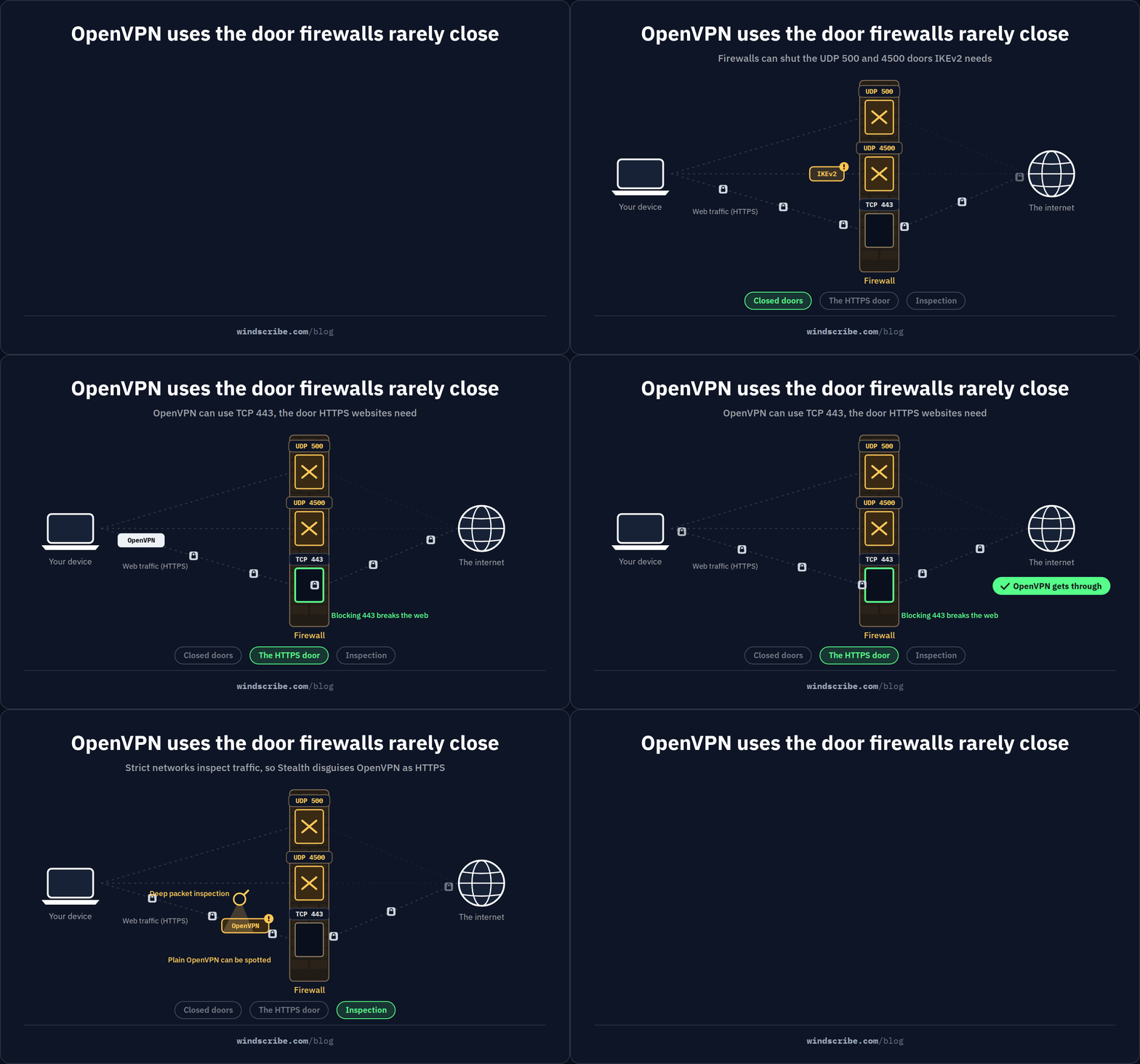
IKEv2 over IPsec is much pickier about where it lives, which makes it easier to block. It relies on specific ports, mainly UDP 500 and 4500. Think of ports like numbered doors on a network. Different types of traffic use different doors. If the firewall shuts the IKEv2 doors, IKEv2 doesn’t sneak in through a window. It just… doesn’t do anything.
OpenVPN is far more flexible. It can run on almost any port, including TCP 443, which is the same port regular HTTPS websites use. If a network blocks it too aggressively, it starts breaking encrypted websites, logins, payments, and half the web people actually need. So OpenVPN on TCP 443 has a much better chance of getting through.
But port numbers are only the first layer. Modern restrictive networks use Deep Packet Inspection (DPI), which means they don’t just look at the door number, but they also look at what’s walking through it. And that’s also where IKEv2 has a harder time. Its packet structure is easy to recognize, so even if you move it off the default port, it still looks like IKEv2. OpenVPN on TCP 443 is harder to distinguish from normal web traffic, but not impossible to fingerprint.
Raw OpenVPN on 443 is the fallback, not the magic trick. If the network is doing real protocol fingerprinting, the actual answer is obfuscation. That’s where Windscribe’s Stealth and WStunnel come in. Stealth wraps OpenVPN in TLS, and WStunnel wraps it in WebSocket traffic, which makes the connection much harder to single out and kill.
Mobile: What MOBIKE Actually Does
MOBIKE is IKEv2’s favorite party trick. That stands for Mobility and Multihoming, which sounds like something invented by a telecom dad, but the idea is actually simple. MOBIKE lets IKEv2 update the client’s IP address inside the existing secure session instead of rebuilding the whole thing from scratch.
In plain English, this means that your VPN connection doesn’t break when you switch between coffee shop Wi-Fi and mobile data.
OpenVPN doesn’t have the same card up its sleeve, and it’s more likely to give you a short little “hang on” moment while it reconnects. It’s usually fast, but fast is not the same as seamless, and on mobile, seamless matters.
That’s why IKEv2 makes much more sense on mobile phones. Apple ships built-in IKEv2 support for iPhone, iPad, and Mac, and Android has platform-level IKEv2/IPsec support too. Android’s own docs note that platform IKEv2 profiles don’t require the VPN app to constantly run in the background. Battery matters, sure, but the bigger win is that the connection survives normal phone behavior without throwing a tantrum.
When to Choose Each
So, when do you need OpenVPN and when do you need IKEv2? The answer comes down to what you need most: speed, seamless mobile switching, or the ability to get through restrictive networks.
| Use case | Recommendation |
|---|---|
| Daily browsing / general use | IKEv2 — fast, smooth, no real downside |
| Streaming | IKEv2 — quick connections, lower-latency feel |
| Gaming | IKEv2 — fast path, better latency odds |
| Mobile | IKEv2 — survives Wi-Fi to cellular hops |
| Torrenting / P2P | OpenVPN UDP — stable sessions, flexible transport |
| Restrictive networks / censorship | OpenVPN — TCP 443 fallback, obfuscation-friendly |
| Privacy-first / high threat model | OpenVPN — open-source code, stronger transparency story |
Windscribe Picks For You And Here’s Why
We get it. No one wants to keep switching protocols every time they move from school Wi-Fi to mobile data to Netflix at home. That is why Windscribe has Automatic mode. It does not guess.
It follows a ladder: WireGuard, IKEv2, OpenVPN UDP, OpenVPN TCP, Stealth, then WStunnel. Windscribe supports all six, and the logic is simple: start with the fastest modern option, then fall back to progressively more firewall-resistant ones only when needed.
That’s also why we offer both OpenVPN and IKEv2 instead of pretending one protocol fits every situation. Mobile users benefit from IKEv2. Restrictive networks often need OpenVPN TCP or an obfuscation layer. Privacy-first users may prefer OpenVPN’s transparency story.
If you are not sure, leave Automatic on and let the app do the protocol goblin work for you.
OpenVPN vs IKEv2 Frequently Asked Questions
Is IKEv2 really faster than OpenVPN?
Historically, yes. IKEv2 has an advantage because it runs in the OS kernel, while OpenVPN traditionally ran in userspace. However, in 2026, OpenVPN 2.6 with Data Channel Offload (DCO) narrows this gap significantly. While IKEv2 remains slightly faster on average, the margin is much smaller than outdated comparison articles suggest.
Has IKEv2 been cracked?
No IKEv2 vulnerability has been publicly demonstrated. While its predecessor IKEv1 is considered compromised and the underlying IPsec suite was a documented target of NSA programs like Bullrun and Logjam, modern IKEv2 implementations using strong Diffie-Hellman groups are currently considered secure by all mainstream cryptographic standards.
Can my network block IKEv2 but not OpenVPN?
Yes. IKEv2 relies on fixed ports, UDP 500 and UDP 4500, which are trivial for administrators to block. OpenVPN can run on TCP port 443, the same port used by HTTPS web traffic. Blocking this would break the internet for most users, making OpenVPN much harder to censor or restrict.
Is OpenVPN still the most secure VPN protocol in 2026?
OpenVPN remains the gold standard for transparency due to its fully open-source nature and decades of public audits. While newer protocols like WireGuard use more modern, streamlined cryptography, OpenVPN is the preferred choice for users who prioritize long-term auditability and a proven track record over newer cryptographic efficiency.
What about post-quantum?
Neither protocol is post-quantum ready by default in 2026. The OpenVPN community currently has a more active trajectory toward implementing hybrid post-quantum key exchange compared to the IPsec working groups. If defending against future quantum computing threats is part of your threat model, this is a trend to watch, not an immediate fix.


