



This last decade has seen the rise of consumer VPNs throughout the world. With governments enacting more censorship and new laws for online ID verification popping up in many Western nations, VPN adoption has only accelerated in recent years. But with the growth of VPNs also comes the growth of VPN marketing.
Consumer VPNs are a mostly-solved problem by this point. The foundation tech that they were built on - traditional VPNs - already existed. They let you take a private network that would require physical access, and remove the physical limitation by extending the private network over the public internet using VPN tunneling and authentication protocols. Using the exact same protocols, you can configure some custom firewall and routing rules on your VPN server, build a simple client that connects to it, slap a logo and a coat of paint on the whole thing and bam! You’ve got yourself a basic consumer VPN you can charge people money for.
When it’s that simple though, how do you differentiate yourself from competitors doing the same thing? You can add more protocols to your VPN, improve your systems to be faster, add features like server-side ad-blocking, but one of the biggest selling points of a VPN is how many locations it gives its users access to.
You might think this is a simple question to answer - just count the number of servers you offer - but many VPNs have chosen to reinterpret that question in a way that gives a much more beneficial answer for their marketing purposes.
A Vague Glossary
To the average person, IPs, servers, locations and countries are all mostly interchangeable terms when it comes to VPNs. But these are actually quite different and knowing that difference will show how VPNs can take advantage of this little linguistic loophole to pump their numbers.
- Countries - this is fairly simple, how many countries does the VPN have servers in? Except it’s not that simple because many VPNs offer virtual locations (explained more below).
- Locations - Think of this as cities/states or in Windscribe’s case, the different datacenters we have servers in like Miami or Toronto. And we can offer 2 distinct Toronto locations because we have servers in 2 different Toronto datacenters.
- Servers - A server is essentially just a box of computer hardware running in a datacenter on which a VPN provider installs their VPN node software. Depending on demand and availability, we almost always have multiple boxes at a single datacenter, but users will still see all of them as one single location in the VPN client.
- IPs - These are the individual IP addresses that you get assigned when connecting to a location. Just about all datacenters can offer you multiple dozens of IPs per server box, and with multiple servers, you can end up with hundreds of IPs in a single datacenter location.
In the case of Windscribe, you might see only 2 Toronto locations in the list, but that doesn’t mean we only have 2 Toronto IPs or servers to offer users. That’s 2 datacenters with multiple servers, each with dozens of IPs. So in reality, 2 Toronto locations equate to several dozen IPs that we can assign to you under the hood.
Linguistic Loopholes
If you operate a VPN, you want the biggest numbers to show to people, and if those people think that a server is the same thing as an IP, well why not just count all your IPs and claim that as your server count?
This is precisely the game that Proton VPN plays, and we proved it. As of writing, Proton claims that their network has 20,799 servers in 149 countries. Both of these numbers have a layer of deception that masks the true numbers.
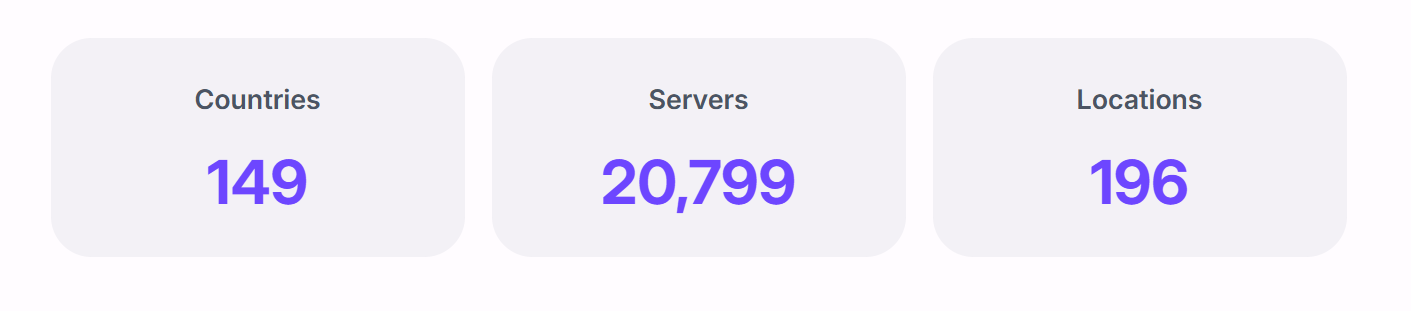
A common way to operate a VPN server is by having one entry IP and multiple exit IPs. You communicate with the Proton server using its entry IP, Proton assigns you one of the multiple exit IPs on that server and uses it to communicate with the web. This makes counting their servers a simple exercise for us.
Let’s take, for example, their Belarus location. Proton VPN claims to have 20 servers in Belarus. Of these “20”, 12 are available to us in their WireGuard config generator.
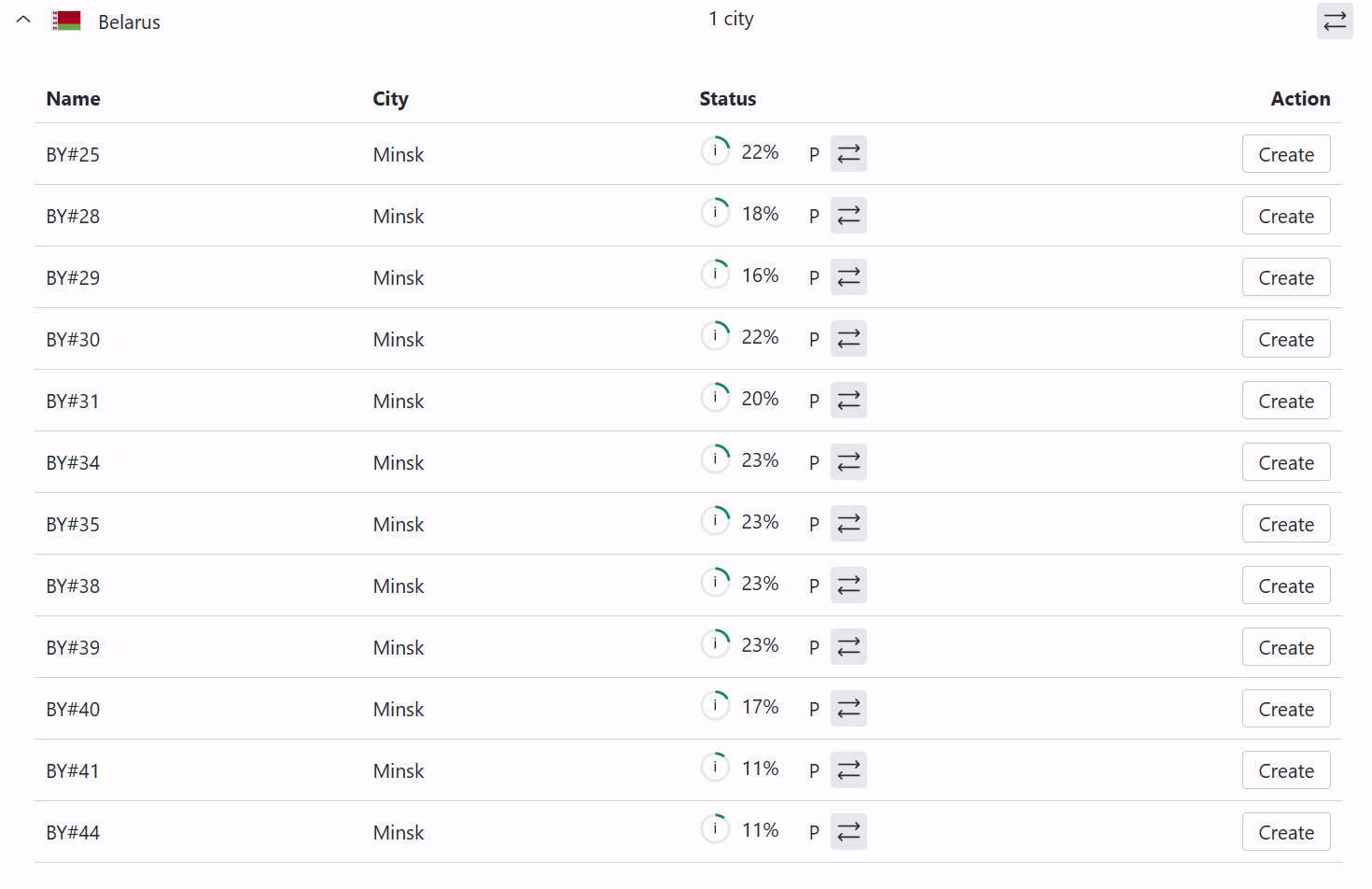
The good thing about WireGuard configs is that we can see both the entry and the exit IPs we’re getting. So we ran through their configs to arrive at the following result:
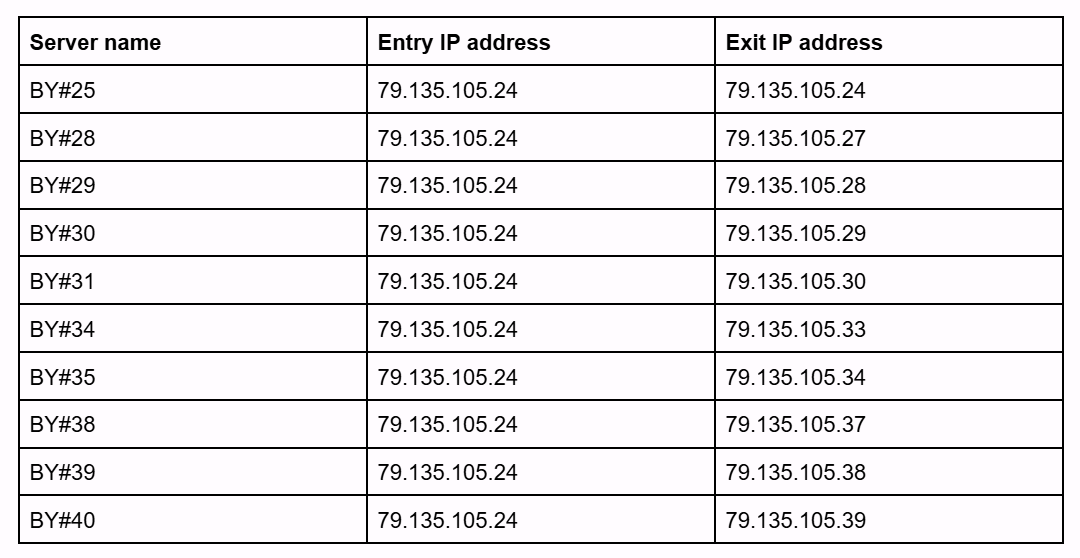
10 “servers” claimed by Proton VPN - all connecting to the exact same entry IP address. All of these are the same server, it’s all the same box in one datacenter. And the proximity of the entry IP to the exit IPs makes it very unlikely that the entry server is some central node sending you off to different servers. Datacenters usually give you IPs in sequential batches, which in this case is 79.135.105.24 to 79.135.105.39.
Suffice it to say, if this location's ratio is 10x, we estimate the network-wide ratio is similar, likely even more. They wouldn’t be wrong to claim they operated, say, 2 servers in Belarus with 10 IP addresses each, but then how would they inflate their server counts that way?
Now don’t forget that there’s a second layer of deception here - none of these servers are really in Belarus.
Virtual Locations
Oftentimes, when a company does something dishonest and customers don’t notice or care enough, they will double down. Then their competitors will see this and join in on the same dishonest practice, and before you know it this is just “how things are done in the industry.” This is how virtual locations became so prevalent in the VPN space.
Whether it’s due to limited datacenter availability, the price being 10x your regular server cost in other countries, or restrictions on what you can operate in that country, there are places where establishing a physical VPN server is difficult. But what if you could have your cake and eat it too?
Enter virtual locations. A “virtual location” is just a fancy label for a fake location. You get a physical server in one country where it’s cheap, and then just slap a label on it saying it’s a location in another country. Almost every VPN does this to some degree.
Going back to Proton, their “Belarus” servers are actually located in the UK, information you can find on their website’s Smart Routing info page.
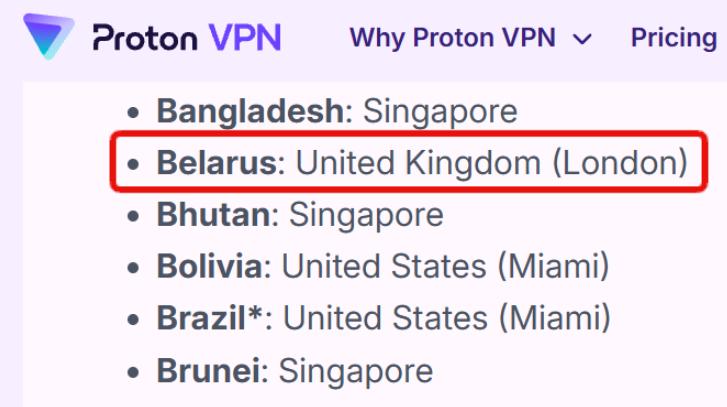
They list 109 countries which have "Smart Routing" servers and after removing the 22 countries which also have physical servers, you land at 87 countries where they offer zero physical VPN servers. 87 countries that Proton does not operate in, but happily include in their 149-country total. In reality the total number is 62.
It’s not just Proton VPN though. We’ve done a deeper dive on this topic in the past and found that at least ExpressVPN, Surfshark, CyberGhost and Hide.me are using virtual locations as part of their network. Some are transparent about it with in-app labels and FAQ pages similar to Proton’s above, others are not so transparent and try to pawn off virtual locations as physical (albeit this might just be poorly trained support staff giving incorrect answers).
But the true deep dive was recently done by IPinfo where they analyzed over 150,000 exit IPs to find that out of 20 major VPN providers, only 3 were not using virtual servers to some extent. Windscribe was, of course, among those 3 exceptions.
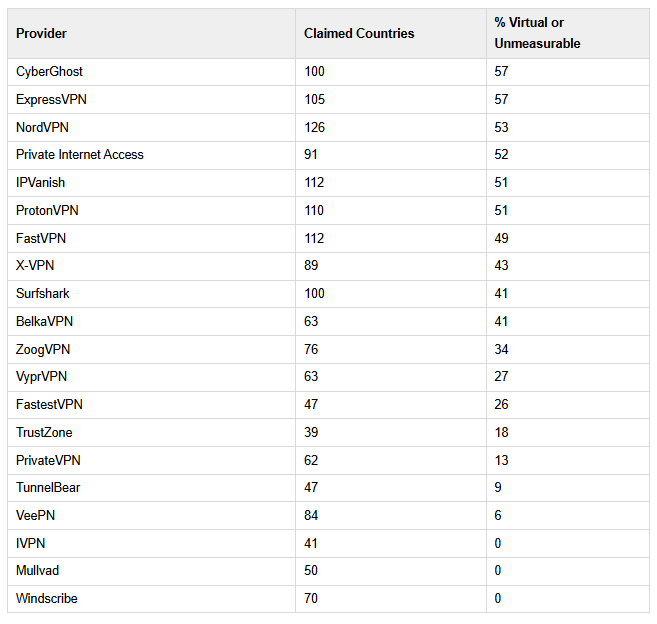
While virtual locations do function as valid VPN servers, they're not a clean solution. The VPN IPs you get from virtual locations are often muddy, not accurately representing to the internet that it’s the country you selected in the VPN app.
PureVPN recently announced that they’re removing almost 75% of their virtual locations, stating that based on user feedback “the IP address assigned to [a user] is not of the country they connected to”, and that there were “inconsistent speeds and network disconnection issues explicitly related to virtual locations.” After all, if you’re in Belarus and connect to Proton’s Belarus location, your traffic ends up going all the way through the UK.
Nonsensical Economics
Operating a major consumer VPN comes with many costs, a major one being the cost to lease the servers in your global VPN network. Being a VPN provider ourselves, we can take the claims other VPNs make about their server count and estimate the cost of operating such a network.
Let’s take a look at Private Internet Access. Across the web, you’ll find a recurring number for their server count - 35,000.
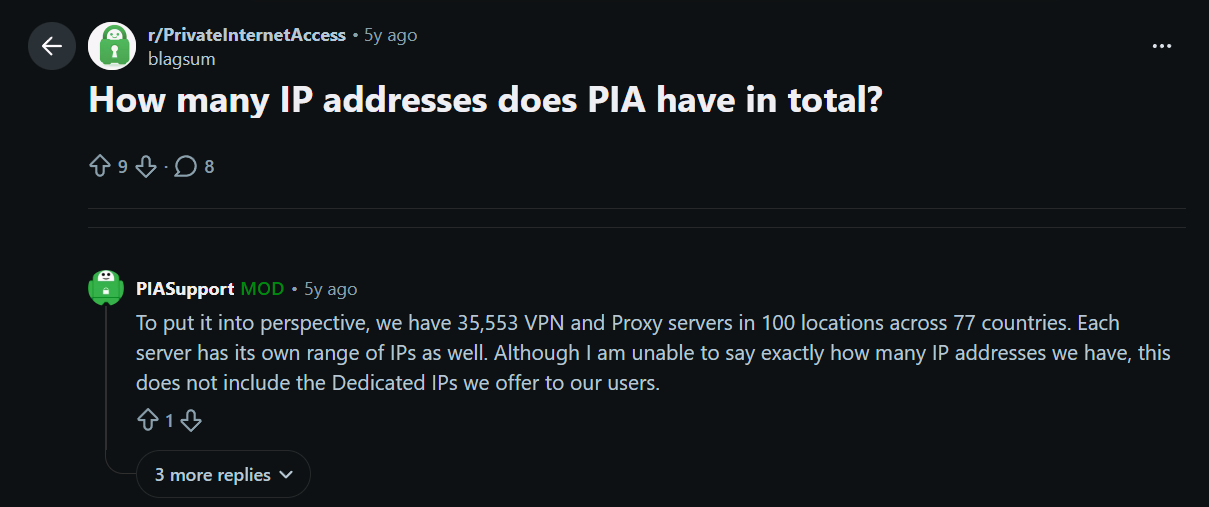
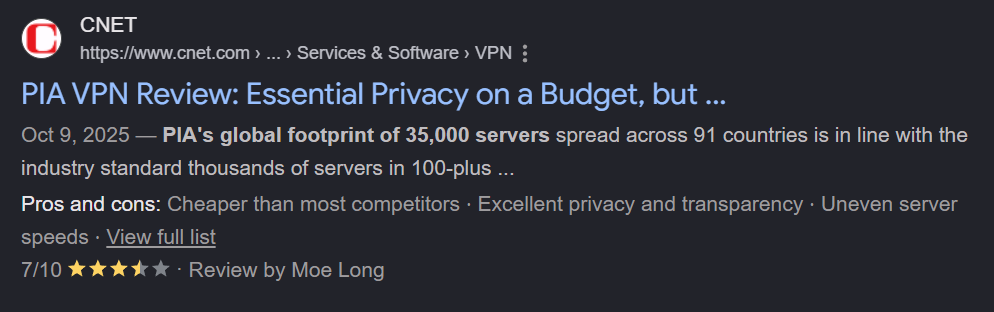
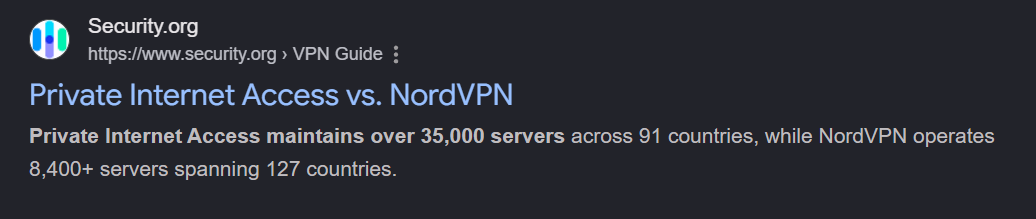
Now remember, a server is a box of hardware that you lease from a datacenter to operate a VPN node. While this cost varies between countries and datacenter providers, it lands on average somewhere around ~$200 USD per server per month. This does NOT include other costs such as the bandwidth and IPs for that server. So if you take PIA’s 35,000 and multiply it by the average hardware cost, it comes out to $7 million per month just to lease their network hardware.
Some research shows they have around 50-200 employees so let’s take a charitable 75, based in USA, Israel, Philippines, Romania and a couple of other countries. Taking a blended average of salaries, we get about $60,000 USD per employee. This leads to about $4,500,000 in annual salary expenses and with the server hardware cost, we arrive at about $88.5M annual operating cost for PIA. This doesn’t take into account legal costs, marketing budgets, office rent or any other expenses outside salary and server hardware.
The last disclosed revenue of PIA is from 2018 at $47.4M before they got acquired by Kape Technologies. Looking through the public financials of Kape since that acquisition, along with a bit of market analysis, we can estimate that PIA is running about $70-85M in annual revenue.
Even at the highest end, this still would not cover their annual operating cost of just employee salaries and server hardware. Then add in all other operating costs and this company would be operating at a massive loss each year.
Or, perhaps the 35,000 server count is simply not true. Let’s assume each real server has an average of 10 IPs (which is a deliberately low estimate). That brings down the total servers to 3,500, total monthly cost for them down to $700k and now salaries plus servers cost them about $13M per year. With legal, marketing, rent and all other expenses, you now end up with a viable picture of a company that makes a nice chunk of profit at the end of each year.
It’s important to note here that these are our estimates. We don’t have access to PIA’s accounting records so we can’t state for certain that all of the above is absolutely true. But even the ballpark figures lead to a logical conclusion that 35,000 servers simply makes little sense. What profit-motivated executive would choose the 10x server cost strategy instead of saving $75M annually? And all they have to do is reinterpret the definition of “server count”.
Blatant Lying
So far we’ve covered cases of taking the truth and stretching it - technicalities that can lead to similar conclusions when interpreted slightly differently - but for some VPNs, even that is too much effort. So they just lie.
Last year we stumbled upon HideMyAss VPN’s website which made a truly bold claim. Off the bat, they claimed to have servers in 210+ countries, and digging deeper on their website they also claimed servers in 290+ countries.
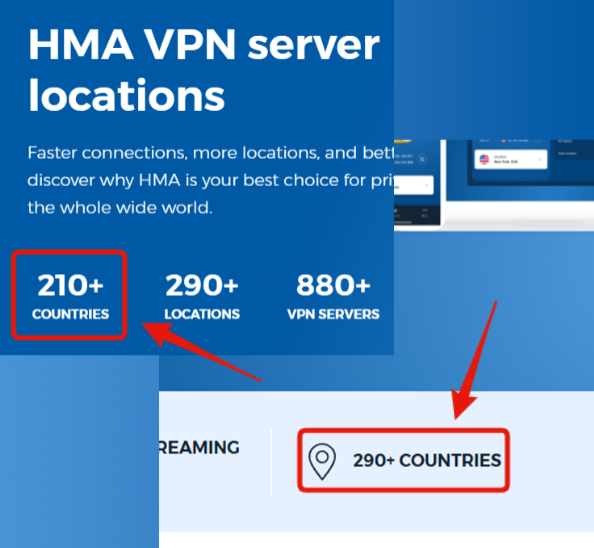
This would be an incredible feat if true. Unfortunately for HMA, their claim has to contend with the actual number of countries on planet Earth - 195.
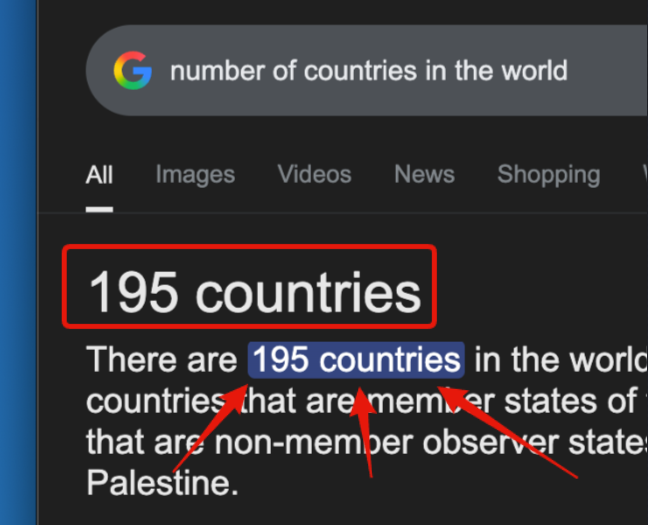
HideMyAss isn’t some throwaway VPN either, they’re decently known and have been around since 2005. Credit to them, they at least fixed the numbers and now claim only 65+ countries which is good because we don’t have to question whether they were lying or somehow became the first interplanetary VPN company.
The same credit cannot be given to the countless no-name garbage VPNs out there. And 'garbage' is an accurate descriptor here, not an insult. It takes significant cost and engineering effort to build a legitimate major VPN service, and there exist thousands of scam apps and browser extensions that make all the same claims and simply offer you garbage. Or worse, malware.
Many people don’t bother with researching VPNs and simply grab the first one they see, not aware of the fact that what they just installed could be stealing their crypto wallets or private credentials, constantly reading their OS clipboard or even screenshotting everything they do in their browser.
We were even on the receiving end of some of this garbage in 2025. While investigating a suspicious VPN app topping the Play Store charts, one of our QA team members noticed that when you connected to their VPN, you got a Windscribe IP. We made a video about it if you’re curious for more info.
So what about Windscribe?
If you know anything about us, you probably know that we’re an honest company. We don’t pay VPN review sites for top spots like most other VPNs do, we don’t offer affiliate payouts to get more signups, and we’re equally honest about our locations.
When it comes to virtual locations, as IPinfo pointed out in their independent research, we have zero. It’s not entirely accurate though. We have since added Fake Mumbai and Fake St. Petersburg, and that’s exactly how they’re labeled in the app - Fake. In rare cases these locations can be helpful. In India, for example, server providers are not top tier, so some Indian streaming platforms will actually host out of Singapore or elsewhere. And so our Fake Mumbai location, also in Singapore, will have better routing for users accessing that streaming service. There is also our location labeled Fake Antarctica, an obvious joke server which is really hosted in Toronto. Apologies if you got excited to finally access Antarctica’s Netflix catalog.
The saving grace for us though, is that we also host physical servers in India and Russia. We’re not replacing physical presence with cheaper bandwidth from other countries, and we’re not inflating our country count because we’re still in those countries.
As for server or IP counts, well we don’t actually publicize those. What we claim is physical VPN servers in 69+ countries and 135+ cities. At the end of the day, these are the numbers that really matter. Do you actually care if we have 10 servers or 15 in Toronto? Do you care if we have 100 or 200 IPs in Dallas? What matters is if you can connect to those locations and get a great service, and that part is where our focus goes.
We could play the same game as most of the other VPNs and publicize our numbers, but then to present an accurate comparison, we’d have to use the same dishonest tricks as them which is counter to our ethics at Windscribe. If we didn’t use those tricks, then people would obviously gravitate towards PIA’s 35,000 or Proton’s 20,799 server counts, not knowing that those aren’t actual server counts. Our CEO summarized it eloquently years ago:

Credit Where It’s Due
Not every major VPN tries to maximize their numbers using linguistic tricks. In fact, the trend has been moving towards what we’ve done at Windscribe - publicizing the countries and locations rather than reaching for the biggest number you can. But honesty is unlikely to be the reason.
As technology improves, it’s easier and cheaper to get a single server offering 10 Gbps than to get 10 separate servers giving you 1 Gbps each. This consolidation will obviously reflect in server counts vastly decreasing, which doesn’t look great for marketing.
ExpressVPN used to claim they have 3,000+ servers back in 2020.

Now though, they don’t publicize the server count at all. But even the number from before is very much believable. ExpressVPN is one of the biggest consumer VPNs on the market, 3,000 servers would definitely fall in line with the size of their user base.
NordVPN doesn’t have a huge, in-your-face server count either, relegating their 8,000+ figure to an unrelated FAQ answer.

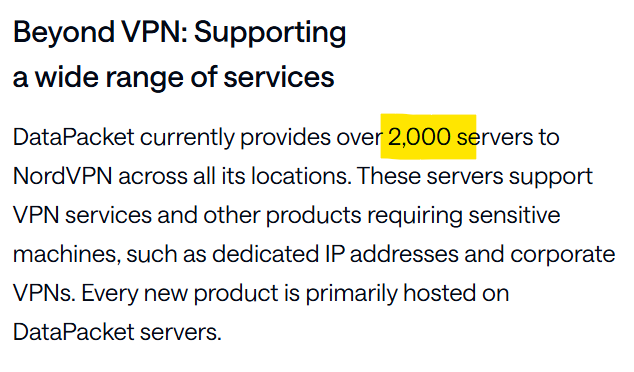
This number has even decreased recently, with a June 3 2026 snapshot showing 9,500+ servers, again, likely due to consolidation to fewer, more powerful servers. But both of those server counts still fall in line with NordVPN’s size in the market. This is further legitimized by DataPacket, a massive datacenter company publicly stating they provide over 2,000 servers to NordVPN.
Do Your Research
Whether it’s Apple showing the vaguest graphs imaginable at their keynotes, or a car commercial saying “Starting at $35,000” while showing you features of the $80,000 model, marketing tricks will never go away. The VPN industry is no different, which is why it’s important to do at least a bit of research. Someone might see PIA’s 35,000 server count, the biggest from any VPN by a massive margin, and conclude that this must be the most popular VPN out there. And before they realize the inaccuracy of that number, they’ve already paid for a 2-year plan.
While there’s some movement towards making fewer of these huge-number claims, as seen by Nord and Express above, they’re still playing the marketing game. Virtual locations still contribute to inflating their country counts, they still have never-ending sales that expire in just a few hours, they still show perpetual 80% off discounts. They’re technically not lying, but they really hope you don’t look beneath the surface of those numbers.


